

Over the course of its just-concluded first season, Widow’s Bay has become an undeniable hit. The Apple TV series, created by Katie Dippold, reimagines nostalgic horror tropes in the guise of a comedy, almost like if Stephen King rewrote Parks and Recreation. It references everything from King’s canon to Jaws, John Carpenter, and A Clockwork Orange while also upending genre expectations and clichés. For Hiro Murai, executive produced Season One and directed five of its 10 episodes, the show feels singular in its ambition.
“There wasn’t an exact comp,” Murai says. “We wanted to make a workplace comedy with a classic sitcom structure, but give it real stakes, and then ramp that up into a horror space. We really swung for the fences. We wanted it to feel unique and like something you haven’t seen before. All of it was a precarious dance. We made choices that might not have worked, but it feels like we got to a place where people would buy it dramatically but we could also push it.”
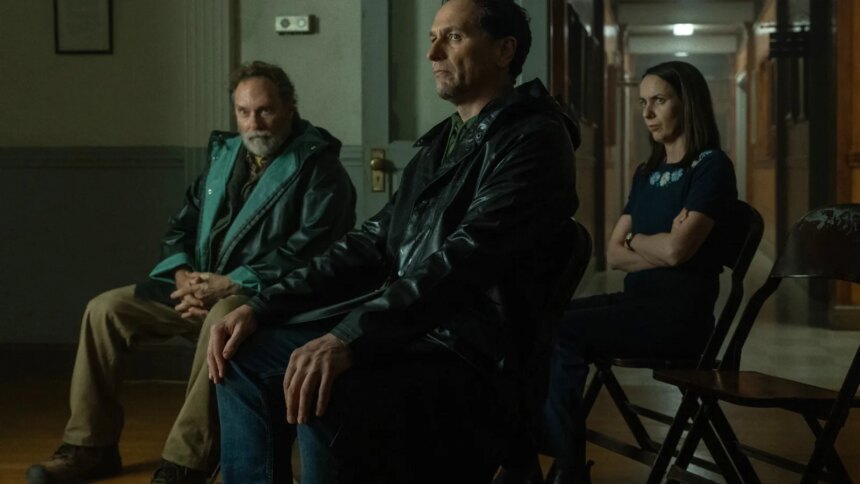
The series, which has already been renewed for a second season, centers on Matthew Rhys‘ Tom Loftis, mayor of a Martha’s Vineyard-like island community in the Northeast called Widow’s Bay. A widower who lives with his teenage son Evan (Kingston Rumi Southwick), who was born on the island, Tom caters to the whims of the quirky Widow’s Bay community alongside his eccentric staff, comprising Patricia (Kate O’Flynn), Rosemary (Dale Dickey), Dale (Jeff Hiller), and Ruth (K Callan).
As Tom prepares to welcome an influx of tourists, it becomes clear that supernatural forces are at play on the island, resulting in the arrival of ghostly clowns, predatory sea hags, and a seemingly familiar masked killer. By the end of Season One, Tom is finally willing to believe the warnings of old timer Wyck (Stephen Root) and takes matters into his own hands to save the island. Each episode works as a stand-alone story, but also plays into the overall lore.
“For the last couple years especially, TV has been really obsessed with the notion of a season as a 10-hour movie,” Murai says. “We liked the idea of harkening back to an older version of TV where an episode of television can be self-contained. There’s something nostalgic about it, too. I grew up watching and loving The X-Files, and you could enjoy that show for its overarching canon or you could just drop into an episode. There’s something really charming and refreshing about that.”
While Murai directed five of the episodes, including the finale, he sometimes handed the reins to other directors who could play up either style, horror or comedy, based on the episode. Horror veteran Ti West (MaXXXine) helmed the flashback episode about the island’s history while Andrew DeYoung (Friendship, The Chair Company) riffed on the comedic chapter where Tom accidentally takes psychedelic mushrooms. Both genres play on the idea of surprise and communal enjoyment, which is what Murai found so compelling about the show overall.
“Horror and comedy both give audiences a collective experience,” he says. “And it right now, especially, it feels really good to share experiences with other people and to feel connected. So much of being scared is about living in the tension of these moments and then knowing that you’re not the only one feeling it.”
Here, Murai discusses the inspirations and references that appear throughout Widow’s Bay, creating the dynamic of the show, and how the finale was put together. (If you haven’t finished the show, be warned: Some spoilers follow.)
Widow’s Bay has been called a “horror comedy.” Did you go into it with that genre in mind?
Horror comedy is the only thing we could think of to say, even though every time we said it we always caveated it with, “We don’t actually like a lot of horror comedy shows or movies.” Because I think that category sounds campier than what we’re going for. So we did the frustrating thing of telling people that it’s unlike anything they can think of, which is a terrible baseline expectation to set. But it was only because we couldn’t think of a better way to categorize it. Episode Two, with the clown, was one of the early episodes where it felt like the right balance of strange and kind of awkward and funny but also genuinely scary.
Where did you draw the line in terms of how far to lean into the horror?
We didn’t explicitly draw a line, but early on when Katie and I talked I got the sense that neither of us were big blood-and-guts people. That’s not the type of horror movie we like. We like the type of horror movie that feels like a roller coaster climbing up, with the anticipation of what’s to come. When is the other shoe going to drop? That feeling is really exciting. We kept calling it negative space, and the negative space is the fun part. You open a door and it’s pitch black and you’re leaning in to see what’s in there. We were really careful not to tip it too bleak or too nihilistic. It should be about the anticipation, and there’s always a little bit of fun inside that anticipation, even when it’s scary.
What were some of the old movies you discussed?
This is a bad example because this is a genuinely scary movie, but one of my earliest horror-movie memories is watching The Shining with my dad when I was nine. There’s moments of absurdism, and they present the absurd in such a deadpan, ambiguous way that I always found really troubling and evocative. It’s strange and funny and absurd and scary, so I was thinking about The Shining a lot.
How much did Stephen King’s legacy play into this show?
We’re playing in a sandbox that he built. That Northeast setting, the extraordinary happening to ordinary people. This genre is his playhouse. We’re obviously doing a comedic slant and picking characters that we identify with in that space, but the frame of it owes so much to Stephen King.
Did you include visual nods to his work throughout the episodes?
We tried not to do too many things where it was a conscious homage or a pastiche. What’s so great about those original pieces, like Stephen King movies or some of these John Carpenter movies that we’re referencing, is they evoked a very visceral, raw feeling. We tried to reverse engineer that feeling rather than doing the aesthetic hallmarks of it. And ultimately, the premise of the show is insane horror tropes are happening to boring, normal people. So the visual language should also feel matter-of-fact and grounded in some way. We try not to get too wrapped up in like visual hallmarks.

Murai, right, with Rhys on set.
Apple TV
The fog does roll in at one point, though.
Of course. And of course when a boogeyman starts walking down the street in the dark it’s supposed to feel a certain way because that’s how we remember those movies. So we’re trying to conjure how we felt watching those movies when we’re young. Maybe it’s a highfalutin way of thinking about it, but it almost feels like we’re trying to harken back to our own nostalgia about these movies. And I think that’s the joy of it and that’s what makes it its own thing. We can operate like modern people, or at least people who’ve seen these movies, but inside the same trope.
Episode Eight really turns the trope of a woman being pursued by a masked killer on its head.
Patricia has been from the start the secret heart of the show. The two bottle episodes that she gets in the season are the most satisfying and relatable arc in the whole show, especially as the character was sidelined in the first few episodes intentionally for comedic effect. I don’t know this for a fact, and you should ask Katie this, but I would guess that Katie has thought about what would happen if someone came into her house with a knife for decades. I think she’s played this out in her head many, many times.
The internet is obsessed with the question of why Patricia doesn’t unmask the killer. Do you know why?
I’ve read this too and it’s fascinating. I almost don’t want to say, but I feel like for Patricia it’s not a mystery of who’s behind the mask. This thing is a manifestation of her trauma and she’s burning it.
Episode Three nods specifically to Jaws, but the whole season plays with our memory of that film. How much was that movie in your conversations about the show overall?
We talked about Jaws a lot for the first block, because we’re playing with the premise of the mayor from Jaws in the whole series. That character is so fun in the movie because he’s weirdly the most complicated one, even though he has so little screen time. Jaws does something really cool that we borrowed from a lot, where on the surface it’s this idyllic town; it’s nostalgic America with this beautiful summertime weather. There’s something about it that feels like overly idyllic, and there’s an undercurrent of tension and danger underneath. That contrast was really important to us in building this world. As a tourist destination on a brochure it probably looks great.
How did you build the tension when Tom goes for a swim under threat from the sea hag?
That moment is funny and strange and scary, but to me it’s about Tom’s anxiety. He’s in front of a bunch of tourists that he’s never met before and he wants to appear as the mayor of this sweet little town and there’s a little bit of performance anxiety. There’s an undercurrent of anxiety under all of it, outside of the sea hag. A lot of this show ended up being about finding a really grounded seed of emotionality and then slowly ratcheting it up and tying it the horror element.
That was something Matthew and I talked about a lot in the beginning. As a person, he’s very naturally funny, but he was nervous that he’d never done like a comedic performance before. Early on, we decided it was important that Tom behaves in a real way to these absurd things. He’s a blah guy who had a traumatic experience with his wife and he’s having hard time letting people in and so the sea hag becomes this thing that encroaches past his comfort zone.
It turns out Matthew is really funny.
A lot of the joy of the show comes from watching him have to deal with all these bigger personalities around him. It was one thing on the page, but so much better in execution. You cut to Matthew’s reaction after Rosemary says something and watch him trying to digest it and that is the whole joy of the show.
The gif of him on the boat has gone really viral.
I am happy people like that. That clip of him was always my favorite shot of the season.
In the finale, Matthew’s scenes with K Callan, who plays Ruth, are really disconcerting. Are we meant to believe that Tom would kill Ruth to save the town?
You’re watching a guy who’s split down the middle and the two sides aren’t talking to each other. One side of him clearly wants to do this so he can save his son and be the hero and resolve this situation. And then the other half — he’s a good man. He’s not going to murder an old woman. The tension is about which side is going to win. K is such a talented actress. I had no idea what she was going to bring because Ruth’s role is so small and comedic up until that point. I realized, “Wow, this could have gone terribly if we didn’t have two incredible actors.” It’s 15 pages of two people talking and it’s so much implied. When Matthew and K were in that room together we were like, “OK, this finale might actually work.”
How much did you want to resolve in the finale and how much was important to leave open for a second season?
There were a couple of different versions of an ending. It felt important to burden Tom with another layer of information and dramatic stakes moving forward, but also be able to reset the board. What works well about the show is that we can drop into tangential stories and mundanity. So it was important to put a period mark at the end of the season, and then double back to less urgent stakes at the top of Season Two.
How much of the lore is definitively figured out at this point?
I don’t want to speak for the writers, but it’s a constant tension. You don’t want to just follow an outline of what you want the big-picture lore to be. Part of the fun of the show is finding story pockets inside of the sandbox. Some of the best episodes of the season are not really lore-related. When you find something fun you have to let that story play out and then you figure out how to incorporate that into the mega arc of the show. So as with everything else, it’s a balancing act.
How early did you want to plant the seeds that Evan is connected to the island’s lore?
That becomes such an important part of the show. I think there’s a mention of it in the pilot, even though Tom lies about whether Evan’s been off the island or not. That was one of the most important things to track through the season considering where it ultimately ends up.
Was the design of the bunker a refence to anything?
We wanted to play with the idea of nuclear bomb shelters from the Fifties and Sixties where it feels modern, relatively. It’s almost like a new layer to the history of the town that we haven’t seen before. Like people in the past have tried to reconcile with this thing and they failed. It felt like a fun way to tell another story of another era in the island. There’s something uncanny about how Brutalist and concrete that space is. And then once you put 300 people in it the space becomes it’s own beast. It was crazy. It was a lot of people. It felt like the crew was going mad in the same way the characters were in that shelter. The set was so claustrophobic and we were there for like four days straight.
What did you want the sacrifice room to evoke?
It was a hard thing to wrap our heads around because it needed to make historical sense. That room has been around since the 1600s, but it also feels like it’s been integrated into the modern version of the town. This is so dark, but we drew references from electric chairs and from the contraption in A Clockwork Orange. Things that make you feel like someone is going to be put here against their will. And hanging off the top is the eye contraption from A Clockwork Orange so whatever there is coming out of that steel door they have to look at it.
The instructional video Dale discovers is also terrifying.
There’s a lot of 1950s instructional video energy in there. There’s something overtly wholesome about the way people talk in those in those things, as if what they’re saying isn’t the most disturbing thing you’ve ever heard. And that’s a big part of the show. Like, is this weird because it’s old? Why did we accept this as normal back in the day? You feel that just being part of the country because it’s the oldest part of the country.
There was some inherently weird layered history in some of the colonial houses and museums we visited. I kept running into paintings of these babies pointing down at the ground. They look terrifying. And the guy who was showing us around was like, “Well, back in the day babies didn’t necessarily survive very long so whenever a baby passed, the family would get a portrait of the baby painted. They’re pointing down at the ground because they want to remind you that they’re buried.” Those are the kinds of things where it feels like it’s straight out of the show, right? Because it’s such a strange, absurd piece of history. We were constantly playing with that.
When you look back over the season, what sequence are you most proud of in terms of creating something that is both scary and funny?
I love the sea hag recliner sequence. It’s genuinely upsetting and it gives you that visceral, pull back in your seat horror. But it has the perfect punchline of the recliner falling and then the hag flying over the chair. That feels like a good thesis statement for the show.