


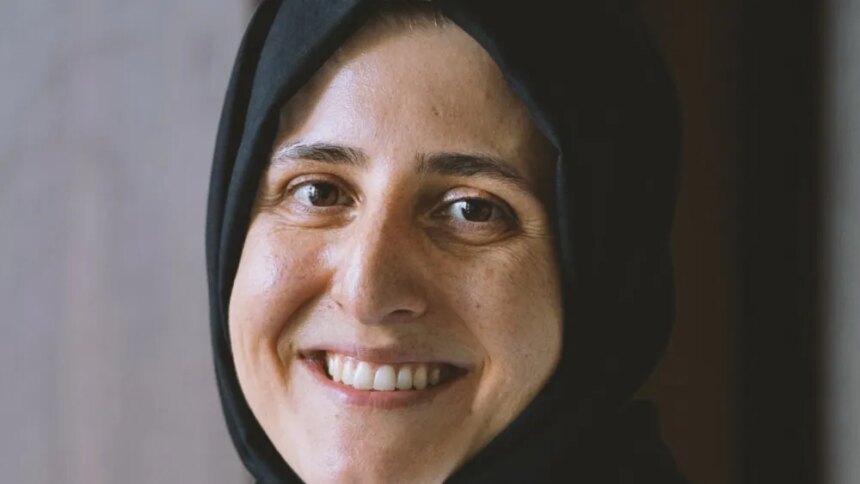
Rising Turkish filmmaker Belkis Bayrak is prepping her sophomore feature, “A Brighter Word Than Bright,” which she’s presenting this week in the Transilvania Pitch Stop co-production forum of the Transilvania Intl. Film Festival. The director’s debut feature, “Gülizar,” world premiered in Toronto’s Discovery strand and played San Sebastian’s New Directors Competition.
A portrait of grief and resilience, “A Brighter Word Than Bright” follows a young literature teacher who, in an effort to protect the dignity of a grieving woman, serves five years in prison for a death he didn’t cause — only to find upon his release that the official truth has erased his sacrifice. Written by Bayrak, the film is produced by Saba Film (Turkey), Arizona Films (France) and Plan Bee Films (Kosovo).
The film begins in a Turkish military barrack, where Osman, a sensitive young conscript, forms a quiet but powerful bond with his superior, Ziya. In the rigid and masculine world of the army, they find sanctuary in poetry and late-night talks — a safe haven that’s abruptly shattered when Ziya takes his own life.
Aware of the taboo around suicide in Turkish society, Osman decides to take the blame for Ziya’s death to spare his pregnant fiancée the shame, isolation and harsh public censure she would otherwise face. To protect her and the future of her unborn child, Osman makes a silent and heavy sacrifice: he insists that he instigated the suicide and spends five years in prison. The film picks up the thread of their story after his release, when the duo reconnects, and Osman tentatively begins to rebuild his life through a love for literature and teaching.
Speaking to Variety in Transilvania, Bayrak described “A Brighter Word Than Bright” as a film “about two men whose presence — and absence — have marked my life.” It draws on a tragic episode in the director’s past, when her uncle, who served alongside her father in the Turkish Armed Forces, died by suicide — a tragedy that her family has never fully come to terms with.
Years later, Bayrak said she was the first among them to openly talk about the tragic death, breaking the silence “that still reverberates through my family.” She sees the film not only as a “gesture of remembrance” for her uncle, but an act of empathy towards the wife, children and other loved ones he left behind, insisting: “Filmmaking is a way of resilience for all of us.”
Taking its title from a poem by John Keats, “A Brighter Word Than Bright” was partly inspired by Jane Campion’s “Bright Star,” a biographical romantic drama based on the last three years of the life of the 19th-century poet. Bayrak recalls being touched by Campion’s evocation of the famous romantic poet, a “fragile” soul in which she says she saw glimpses of her father, a man who — much like the lead character, Osman — “managed to overcome life’s challenges with a gentle and restrained nature.”
In order to shape the world of the film, which is set in the 1990s, Bayrak delved into her family archive for inspiration, unearthing old photos and letters to recreate the mood of the time. She said she encountered many “beautiful moments” on this “nostalgic journey,” but could “always feel the loss” of her uncle lingering outside the frame of each photo and beyond the margins of every page.
Bayrak describes her uncle as a man who struggled with his explosive temper, and it is in part the question of masculinity that she hopes to explore, offering “a different representation of male characters” on screen.
“I believe that, today, the definition of ‘male’ and ‘masculinity’ is very problematic. That is a burden for everyone,” she said. “The definition of what is masculinity is changing. It’s more rigid. There is less place for perception, understanding, empathy.
“We’ve seen countless films set in military or war environments that glorify heroism and masculinity. But I have always been drawn to those who stand quietly at the margins whose fragility is not weakness but endurance,” she continued. “Osman is such a character. His story is about the long emotional aftermath of sacrifice, the impossibility of returning to who you once were, and the hesitant rediscovery of tenderness through teaching and art.”
The Transilvania Intl. Film Festival runs June 12 – 21.