

T
he two sheriffs approached the house slowly, hands resting on the grips of their pistols. They had backup parked nearby — a couple of cars lining the two-lane Appalachian road and idling in the driveway. After they knocked politely, they stepped sideways, moving away from the house’s front door. This is a standard maneuver for police approaching a house for a very simple reason: Doors do not stop bullets.
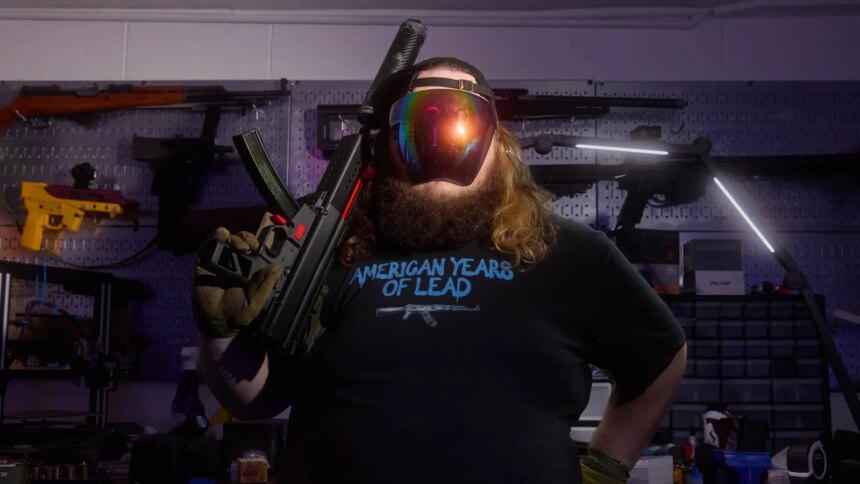
Inside the house, a 33-year-old amateur gunsmith who goes by the pseudonym Yeezy wondered what to do. He’d had run-ins with the authorities before — an hourslong search by the TSA in an airport most recently. A solidly-built man with long, wild hair and a beard who partially hides behind an iridescent face mask online, Yeezy has amassed tens of thousands of followers across social media sites by posting a mix of far-left political memes and his related, but far more tangible hobby: 3D-printed firearms. For years, he’d wondered when his combination of inflammatory commentary and weapon-making would bring the cops down on his head. It seemed like only a matter of time, as his most popular slogan was a direct challenge: “The Second Amendment Is for Shooting Cops.” The officers didn’t have a warrant — they’d been by once before that day, but left before he’d answered the door. This time, they were willing to wait. Yeezy checked his doorbell camera. The two deputies near the door wore black body armor over their uniforms. Another officer lurked farther away from the home.
The house behind him was full of weapons, many of them built from printed frames and untraceable parts with no serial numbers. Nothing in his house was illegal, technically — everything he made was for personal use, with the proper paperwork filed. Still, Yeezy was careful. Next to the front door, an AR-15 rifle made from unregistered parts and a hand-milled aluminum frame leaned against the wall, loaded with armor-piercing ammunition. Yeezy hoped he’d never have to use it.
One of the deputies shone his light through the window and pounded on the door again.
“Can I help you guys?” Yeezy replied.
The cops said they were there with paperwork, not handcuffs. Yeezy was being served a subpoena related to a civil lawsuit between two other gunmakers that otherwise didn’t concern him — a mundane, bureaucratic interaction that rarely involves body armor. He stepped out, barefoot and empty-handed, standing on his doormat, which reads: “Don’t Let the Cat Out or the Cops In.” After a short conversation, he took the stapled sheaf of paperwork inside. The deputies drove away. The AR-15 stayed by the door.

Guns at Yeezy’s workshop are made from real parts combined with 3D-printed plastic materials.
Brian Kaiser
The Plastic Revolution
Yeezy, which is a pseudonym based on his online handle, “YZY PRINTS,” is one of a growing number of amateur gunsmiths dedicated to pushing the limits of 3D-printing technology and America’s gun laws. In the past half-decade, 3D-printed firearms have expanded from a niche hobby to a flourishing economy with thousands of participants across the world. In the United States alone, hundreds of hobbyists design, build, and test new gun designs at a staggering rate, iterating off one anothers’ successes and often stress-testing designs by releasing them to online communities devoted to perfecting the art of the plastic gun. Yeezy is an amateur designer: He is quick to admit that he’s not an expert engineer like many of his peers. But his designs have had instant impact: His calling card is a Glock handle that also functions as a bong, called, predictably, the “Glong.” He’s also contributed to more-notorious designs. In one of our first messages online, he mentioned he had helped develop and test a design for a sound suppressor that was eventually used by Luigi Mangione, who allegedly used a 3D-printed weapon to kill healthcare chief executive Brian Thompson. (Yeezy had no contact with Mangione.)
Many of his designs can be found in massive, free online repositories, where anyone with an internet connection can download the design files necessary to print a weapon at home. In recent years, as well, 3D-printing technology has advanced significantly, with new machines capable of printing more durable, more precise weapons in less time than before. The technology has advanced so quickly, in fact, that its end result — untraceable weapons, assembled from spare parts and plastic frames — often confounds existing laws and presents a unique enforcement problem for authorities. In most states, it’s legal for anyone to build a firearm for personal use. Only seven states have outright banned 3D-printed weapons. There are caveats, of course — America’s gun laws are anything but consistent — but most 3D-printing gunsmiths operate within the letter of the law, carefully walking lines and navigating legal gray areas where applicable.
In the past, gunsmithing was a specialized skill. Creating a reliable, working firearm required years of technical study and access to complex machine shops. The plastic revolution has changed that, and law-enforcement sources and gun-control organizations maintain that 3D-printed weapons represent a new threat to public safety — extremists, criminals, or domestic abusers manufacturing traceless weapons with ill intent, children building functioning guns they see on social media, all with even less government oversight than America’s traditional firearms market. Unserialized and homemade firearms, opponents say, could easily allow criminals to bypass red-flag gun laws, which aim to prevent domestic abusers and other violent individuals from obtaining firearms. Authorities in California and New York have already brought lawsuits and legislation against online repositories of gun files like the ones Yeezy contributes to, and sought to crack down on the physical manufacture of weapons in their jurisdictions. It’s too early to tell if these measures will prevent what the authorities fear — but Yeezy and his compatriots are determined to keep printing regardless of the cost.
“This technology isn’t really driven by the street criminal,” says Bonnie Seok, an assistant district attorney for Manhattan who works in the office’s 3D-printed-gun unit. “It’s driven by an ideology — they’re dedicated to the Second Amendment and democratizing the process of being able to access your own guns. It’s driven by incredibly smart people. They’re always trying to defeat regulations. They’re always trying to outsmart law enforcement.”

Most 3D-printed guns are made of a printed frame known as a lower receiver onto which a user can then install real, factory-made gun parts.
Brian Kaiser
The creators in this ecosystem represent a wide range of political views, from the far left to the far right, but almost all of them share a maximalist interpretation of the Second Amendment, in which the gun is the ultimate symbol of liberty: a tool, a weapon, and an inalienable right. Traditional gun enthusiasts have waged a running battle with the Department of Justice’s Bureau of Alcohol, Tobacco, Firearms and Explosives for generations, but the 3D-printed revolution is a new, more polarized frontier. And some creators, like Yeezy, see their right to print guns as an essential bulwark against the darkest excesses of America’s current government. On social media, Yeezy describes himself as a “far left trantifa extremist,” combining the words “trans” and “antifa” for peak provocation, even though he is not transgender.
In simpler terms, Yeezy believes everyone, regardless of their identity, deserves the ability to buy, build, or carry whatever armament they want. But in Donald Trump’s America, Yeezy and many other creators, shooters, and activists no longer see that right as a given. Left-wing gun enthusiasts worry they may be the first to feel Trump’s boot, as his administration has declared “anti-fascist” groups to be domestic terrorists and stepped up efforts that may prevent specific groups, like transgender people, from owning firearms.
The solution, Yeezy thinks, is plastic: If the government tries to stop certain people from owning guns, 3D-printing technology means it is now easier than ever for them to just make their own.

Yeezy puts together one of his homemade firearms.
Brian Kaiser
An Arsenal in Appalachia
The first gun Yeezy fired, he says, was an illegal machine gun. It was decades ago, and it belonged to a wayward relative. His family was poor, like so many others in the Appalachian Mountains. His mother was disabled, and at times got only $32 a month in food stamps. “I watched the world around me slowly crumble,” Yeezy tells me. His grandfather’s house was foreclosed on; his mother got sick. Still, he “did the things [he] was supposed to do.” In high school, he was a “mediocre” student, but excelled in computer-science classes. He enrolled in college, pursuing an engineering degree, but got crushed by the costs. He sold his car for tuition and slept on couches in the summer, technically homeless. After a year, he dropped out, moving back in with his parents to look for work. “Look at how much we have to go through to get even a little bit of scraps,” Yeezy says. “I don’t have a positive view of the American dream working out for someone like me.”
In the fall of 2020, he printed his first gun, on a cheap 3D-printer he’d bought early on in the pandemic lockdowns, after falling down a rabbit hole of YouTube videos and tutorials on DIY weaponsmithing. The feeling was liberating. Anyone who has fired a gun knows it is an immediate, tactile feeling of power. Yeezy had discovered that he could create that power in his own house.
“This technology is driven by an ideology. They’re always trying to defeat regulations.”
“The right to bear arms — it’s innate to your humanity,” Yeezy says.
On a sunny weekend in mid-April, I drive several hours from Columbus, Ohio, to meet Yeezy at his home, a small property deep in the Appalachian Mountains. We’d been messaging online for months, and I wanted to see his work up close and understand the role it might play in the country’s political future. When I pull up, Yeezy pops out of his garage — shorter than I expected, with a classic mountain man’s wild hair and beard. His face is bare — the first time I’ve seen it without the iridescent, full-face visor he uses in online videos — and he’s wearing a black T-shirt emblazoned with an image of a 3D-printed gun and the slogan “It Was Never About Hunting,” referring to the Second Amendment. Online, Yeezy hides his identity to protect himself and his family from the threats and abuse he receives regularly from right-wing elements of the gun industry and “the brunch liberals”; he requested a pseudonym for this story for the same reason.
He lets me in the door, watching carefully for any escape attempts by Boots, his mischievous tuxedo cat. Funnily enough, Yeezy’s life now is kind of the American dream. He is reluctant to discuss anyone close to him — again, concerned for their safety — but from what I can see, he lives in a stable home and has a supportive and loving network of family and friends. Last year, he even left his well-paying day job as a commercial drone pilot for a mundane corporation, as his income streams from social media, merchandise sales, and a non-firearms 3D-printing business were enough to support him.
Yeezy sells the “Hunting” shirt he’s wearing in an online shop for around $27. While he doesn’t sell firearms or parts — all of his weapons were made legally for personal use — the rest of his online store is filled with other provocative designs. One popular item is a shirt that says “American Years of Lead,” a reference to sectarian political violence in Italy from the 1960s to the 1980s. The back of the shirt puts that concept in uniquely American terms: “The Second Amendment Is for Shooting ICE.” He sells a variant that replaces “ICE” with “Cops,” and stickers asking customers to “Challenge Their Monopoly on Violence.” One design, an image of a guillotine surrounded by the words “Deny, Defend, Depose,” is a nod to Mangione, who allegedly wrote those words on the bullet casings left at the scene of Thompson’s murder. And yet, Yeezy says that violence is the last thing he wants. “As much as I like bloviating online about shooting cops,” Yeezy says, “the idea of killing anything doesn’t bring me joy.”

The results of Yeezy’s target practice.
Brian Kaiser
All of that work — printing guns and designing bumper stickers — happens in Yeezy’s basement lab, which is a tinkerer’s dream and a gun-control advocate’s nightmare: two rooms of workbenches, idling 3D printers, wire racks stacked high with a rainbow of spools of the plastic filament that serves as the raw material for all of his designs. And everywhere, everywhere, there are guns: half-built plastic frames scattered across desks, an antique Soviet rifle hanging from a hook. A black and red toy-like 3D-printed .22-caliber rimfire rifle, several iterations of a 9 mm gun (both metal and plastic), a short-barreled shotgun, and what appears to be half of an AR-15 hung from a pegboard above one workbench, one corner of which was taken up by a large plastic bucket overflowing with live rounds of nearly every shape and size. “We call that ammo salad,” Yeezy says. Yeezy’s favorite rifle, a custom-built version of an AK-47, hangs on a wall mount above an expansive PC workstation, with wrap-around monitors, a podcast mic, and several strips of LED lights, programmed to glow in a techie shade of neon purple. At one point, I move a hat sitting on a stack of Rubbermaid storage bins and find a loaded handgun underneath.
The real stars of Yeezy’s workshop are the printers. He has three, all told, but two that he uses regularly. Minutes after we arrive, we get to work. From the gaming PC, which is bumping “Handlebars” by Flobots when we sit down, Yeezy downloads a CAD — or computer-assisted design — file containing the schematics for a homemade version of a 9 mm pistol called the “ModMac.” He fires up the printer’s software and loads in the design, tweaking various settings in a complex, but not unintelligible set of menus he explains along the way. After a quick check that the printer is loaded up with filament and calibrated correctly, he clicks print. The machine whirs to life, the smell of hot plastic slowly seeping into the air. In about 24 hours, it will produce a gun.
“This is the type of shit I stay up all night doing,” Yeezy says, while wrestling with a hunk of plastic. The work is tactile, delicate, and all-consuming: Beads of sweat roll down his face as he scrapes out a gun part with a file, his fingers black with oil and plastic dust. “It’s so satisfying. I can’t wait to shoot this.”
Making that weapon operational, however, is another process. Like any good baking-show host, Yeezy has prepared a batch of parts before we arrive: a slightly different gun modeled after the famous German-made MP5. Plastic comes out of the printer in an almost unrecognizable state, covered in oddly organic-looking tendrils of plastic called supports. These thin plastic branches are designed to break off after supporting the main architecture of the print while it forms. Yeezy tears into them with pliers, slowly cleaning up the gun’s frame. He pulls up a YouTube video by the gun’s designer, a creator who goes by IvanPrintsGuns, and carefully follows the instructions over the next several hours, slotting metal parts into the frame, and carefully inserting the delicate trigger components into the lower receiver.

There are three printers in Yeezy’s at-home workshop.
Brian Kaiser
Printed guns are a bizarre combination of high and low tech: it’s not uncommon to see a state-of-the-art, factory-made scope mounted on a weapon held together by a common garden-hose clamp. But when you pull the trigger, the result is the same: 3D-printed guns shoot the same bullets used for factory-made firearms.
Yeezy works into the evening, hacking at jagged spurs of plastic and tapping away with a special brass gunsmith’s hammer. His fingers are nicked and scarred from pinches and scrapes. “Often, these things demand blood,” he says.
It’s surprising, too, how easy it all is. There is plenty of patience, expertise, and elbow-grease needed, but the general process of 3D-printing a gun has been distilled down to the “point where an idiot would be able to build it,” Yeezy says. Most designs follow the same general concept: a printed frame known as a lower receiver onto which a user can then install real, factory-made gun parts like the barrel, slide, and bolt assembly. The lower receiver of a weapon is often the only part that the ATF technically classifies as a “gun” — on factory-made weapons, it’s where the serial number is usually engraved. That little idiosyncrasy of the law means you can buy a “parts kit” for most guns — everything except the lower receiver, basically — for a heavy discount with zero paperwork, background check, or serial number involved. In most states, you can get as many kits as you like delivered right to your front door.
“I know of people who have shipping crates of AR-15s,” Yeezy says. “But I have reason to believe they’re watching my mail — if I were to buy 75 [kits], I bet you anything, Homeland Security would be here in an instant.”
Yeezy has some evidence to back this up. In January, when he was headed to Las Vegas for the annual SHOT Show — call it Coachella for gun nuts — he was pulled into an hourslong security screening by TSA as he attempted to board his flight. After a long interrogation and two separate searches, he was allowed to fly — but the experience left him shaken, and even more convinced that his online activities had raised flags on some level of federal law enforcement.
The Fight Against Printed Guns
It’s true: Cops are obsessed with 3D-printed guns. In February, the California attorney general’s office brought a massive civil lawsuit against several gunmakers and the Gatalog Foundation, which operates one of the many online repositories of firearm designs, alleging that Gatalog’s operators were “accountable for promoting and facilitating the unlawful manufacture of 3D-printed firearms,” as the website was accessible in California, where it is illegal (the Gatalog Foundation is incorporated in Florida, where printing weapons is legal).

Yeezy hosts firearm training courses at his home.
Brian Kaiser
In New York, Manhattan District Attorney Alvin Bragg has also made them a priority. In May, I visited Bragg’s office in the middle of a statewide push for new legislation on 3D-printed guns. In a conference room, Bragg and his staff lay out the contents of several evidence lockers in front of me — at least a dozen different printed guns and several seized printers from busts around the city. I pick up and fiddle with some of the printed guns, unsure if I should admit that I had shot most of the designs on the table a few weeks earlier at Yeezy’s. Two detectives from the NYPD’s ghost guns unit sit quietly in the back of the room, keeping custody over the brightly-colored plastic paraphernalia.
“I became a prosecutor in 2003 — I’m used to the iron pipeline,” Bragg says, referring to the flow of weapons into New York City from states with looser gun laws. Guns are heavily restricted in New York City, and New York state’s laws require manufacturers to stamp any parts they create with trackable serial numbers, something not required in many states. “But the sort of potential ubiquity of this — that you can just do your dishes, watch ESPN, and, like, print a gun at the same time … I mean, it’s scary.”
But combating ghost guns is a constant, shifting battle. As Seok, the Manhattan assistant district attorney, tells me, creators are constantly finding ways around the system. In Manhattan, Bragg’s office has petitioned 3D-printer manufacturers like Creality to take down user-submitted gun designs on their official libraries — but they have had little jurisdiction over the many open-source, third-party websites publishing CAD files online.
Bragg and Seok’s latest hope is a set of new provisions in the New York state budget that add criminal, not civil, penalties to the act of even printing a gun in the city. Such a law is likely to be challenged immediately in court, as New York has an active community of litigation-happy gun-rights advocates who have won several landmark decisions in recent years. Later, in Seok’s office, I ask if it ever feels like she’s fighting a losing battle.
“It doesn’t feel futile to me, or to the team,” Seok says.
“If someone is going to attack me because of my identity, i can’t trust them to just stop.”
“In terms of the legislation — it gives us tools to be able to grapple with this problem. We’re always trying to stay ahead.”
But despite all of the attention, it’s hard to exactly pin down how big of a problem this is on the street. The NYPD claims that of the 438 ghost guns from crime scenes in 2024, 109 of the weapons were allegedly 3D-printed. (The term “ghost gun” can apply to any kind of weapon with an unclear origin and no serial number, including guns constructed from premade kits, home-milled metal, or polymer kits, as well as 3D-printed weapons.) Some of the 3D-printed weapons recovered by New York authorities came from large, notable busts — an arsenal on the Upper East Side belonging to the brother of actress and model Julia Fox that was uncovered in March 2023; a case where a man in Harlem was printing weapons at his apartment and test-firing them in Central Park (both the manufacture and test-firing are not legal in New York City); and the 2023 bust of a group of minors and adults who were 3D-printing guns at a daycare center in Harlem.
A few weeks later, I dropped by One Police Plaza, a grim brick complex in downtown Manhattan, to meet the head of the NYPD’s ghost guns unit, Chief Courtney Nilan. After passing through several metal detectors, an aide leads me up to the unit’s offices on the second floor, where Nilan, a wiry woman with a scraped-back bun of blond hair, gets straight down to business.
“All the stats you get for ghost guns and 3D printing — I think it’s completely underreported nationwide,” Nilan says. What she can prove, she says, is limited: Thompson’s shooting is the only murder thus far in her jurisdiction that definitively included a 3D-printed weapon. “But do I think there have been [more killings with 3D-printed guns]?” she says. “One thousand percent.”
In many shootings, Nilan says, the weapon used is never recovered. And even when it is, she says, the officers cataloging evidence have to know what to look for. Good 3D-printed weapons, particularly handguns, can often be somewhat indistinguishable from factory-made firearms: I saw several of them myself in Yeezy’s shop. A big part of Nilan’s unit’s responsibilities includes training other units on what to look for. Security teams, for instance, can often miss 3D-printed guns in metal detectors — even at government facilities (though the guys downstairs at One Police Plaza, she says, know exactly how to spot one).
What worries her is where the technology is trending. In the early 2020s, she says, her team was busting mostly hobbyists — people who were printing guns but had no intentions of using them. That describes, she says, the vast majority of the “3D 2A” community — Second Amendment ideologues like Yeezy, in other words.
“Even though they’re loud [online] — they’re not committing any crimes,” Nilan says. “Neither are the beta testers, everyone in the design rooms — it’s once that design is perfected and put out on the open web, that’s where it’s hitting those who have nefarious purposes.”
Nilan says that anecdotally, the technology seems to attract extremists: A 2024 bust in Queens brought in a pair of brothers who had put together a hit list that included cops, judges, politicians, and “banker scum,” who they planned to attack with an arsenal of 3D-printed weapons and improvised explosives, as well as two recent raids where “the people have been, I know this sounds crazy, like, Satanists.”
These, she says, are her unit’s actual targets. Opportunists like the daycare group, which was selling weapons, and extremists — not the hobbyists. Nilan says ghost-gun cases often play out more like financial-crimes investigations than weapons deals, as so much of the evidence is online and through electronic and paper records. “Our biggest partner is Postal,” she says, referring to the U.S. Postal Service police. (I immediately think back to Yeezy saying that he was certain they were watching his mail.)
The ghost guns unit — whose unit insignia reads “If You Build It We Will Come” — has seven members, in a police force that employs roughly 35,000 cops. It feels like we’re on the precipice of something that will revolutionize the way people — criminals and civilians alike — arm themselves.
“I’d heard of the Liberator [the first famous 3D-printed gun],” Yeezy says. “I remember seeing that, and I was like, ‘Oh, this is going to change the world.’”
But now, it’s still a marginal problem — one that only a department as big as the NYPD can really afford to focus on.
“I think it [the ghost-gun problem] is growing slowly,” Nilan says. “It’s not in its infancy stages, but I don’t think it’s blown up how it’s gonna blow up.”
The Years of Lead and Plastic
Back in the workshop, Yeezy’s printer continues to churn out a new gun. Over the years, he estimates, he’s printed around 100 frames and receivers and assembled 30 to 40 functional firearms. While the printer works, we take the fully assembled MP5 out to his backyard shooting range for its first few test shots. After slotting in a factory-made 30-round magazine loaded with 9 mm rounds, Yeezy slaps the bolt forward, turns toward his target, and lets loose: Bang bang bang bang bang. He rips through the entire magazine on semiautomatic fire, the hard-polymer gun jumping up and down in his hands, sending a stream of lead downrange. As far as the government knows, this gun doesn’t exist.

Yeezy estimates he’s printed and assembled dozens of firearms.
Brian Kaiser
After the first magazine, our printed weapon runs into trouble. When we fire a few test shots through a printed suppressor (that Yeezy filled out the proper paperwork for and legally owns), the gun starts having issues cycling in a new round. He thumps the butt of the gun, taps it on the side of his quad bike, jiggles the bolt, and tries to coax it into action with lubricant. Nothing works — the gun is seized up, the bolt sticking on some unforeseen burr of filament as the plastic slowly breaks in. Yeezy is frustrated, but we have plenty of other guns to shoot: his regular carry pistol, a 3D-printed Glock clone; a shotgun, and a few other surprises.
The sense I get in Yeezy’s basement is that 3D-printed weapons are a genie that is impossible to entirely force back into the bottle. In a competent gunmaker’s lab, it doesn’t matter which side of the legal battle over printed weapons is “ahead.” It doesn’t matter if the major websites of CAD files are taken down, or even if printers come uploaded with firmware designed to stop them printing weapons. There will always be workarounds. One of the first mass-produced 3D-printed firearms, designed by a legendary engineer known as “JStark,” was dubbed the FGC-9. The initialism stands for “Fuck Gun Control,” the nine for the 9 mm rounds it shot. FGC-9s have been built by underground designers in the most firearms-restrictive countries in Europe and churned out by rebel groups in Myanmar.
The possibilities of 3D-printed weapons are rapidly expanding, too. “The diversity of creations is incredibly impressive given the limited resources of developers,” says “Wirb,” who runs a group that helps 3D-printed designers produce and market their products legally. His clients include designers working on everything from drone munitions to 3D-printed rocket launchers. (He requested a pseudonym to protect his and his clients’ privacy.) “There’s been, offhand, grenade launchers, hand grenades, claymores, mortars, and even 37 mm howitzers, though those are apparently very experimental right now,” Wirb says.
This is all taking place in the best-armed nation in history. There are somewhere around 500 million guns in this country – more firearms than people, more than homes, more than cars. “We don’t live in a world where there just aren’t guns,” Yeezy tells me. “No matter how you feel about it, they’re not going anywhere.”
For Yeezy, having a gun means having power. “Liberals ultimately believe that at some point the government will do something for them,” Yeezy says. “I believe in seizing the means to own your own life. You don’t get to offer nothing of value to my life and also exert so much control over me.”
In 2023, I reported on a growing trend of left-wing, predominantly LGBTQ+ activists who were forming armed collectives to defend their communities from right-wing militias and hostile police. Many of the people I talked to lived in Texas, a state where lawmakers have passed laws that restrict the rights of gay and trans people. Members of those communities saw guns as a necessity in the face of constant threats from right-wing groups, who they claimed were often ignored or even enabled by the police. Online, as well, organizations like Arm the Dolls focus on education and resources that help trans and marginalized people purchase and familiarize themselves with guns.
“If someone is going to attack me because of my identity, I can’t trust them to just stop at some point,” says Nell, the founder of Arm the Dolls. “Attacking a person for who they are is a crime of passion. I have to assume lethal intent. That means pepper spray may not be enough.”
Last fall, Yeezy invited several trans members of his online community to his house for a basic firearms training course. Over the weekend, he taught around 20 people, mostly trans women, how to shoot, and explained the basics of 3D-printing guns. The latter point was important, because there are signs that for trans people, the right to bear arms may soon truly be infringed. In May, the Department of Justice’s Bureau of Alcohol, Tobacco, Firearms and Explosives proposed a new rule that anyone filling out federal firearms paperwork must indicate their biological sex on the forms. Trans people whose government identification is affirming — reflects their chosen gender — would have a mismatch with the forms, a bureaucratic snag that Nell and other activists say could, in some cases, restrict transgender Americans from purchasing weapons. The ATF’s proposed change is one of many small encroachments activists like Nell have been tracking for years. The solution, Yeezy says, is a 3D printer.
“How bad do you want [a weapon]?” Yeezy says. “If you want it bad enough, you can figure it out. It just comes down to willpower.”
Yeezy wants it bad enough. And based on the arsenal I saw, he has a lot of willpower. His reasoning for it is simple: Every experience he’s had in his life has convinced him that the government will never be on his side.
But if he’s right, if that’s where we’re headed, it’s a deadly future, because the brutality of American life taught Yeezy and others like him that the only way to live was by reserving the power to kill.