


I
t’s summer in New York City. Jackhammers pound outside my hotel room at 6 a.m. Rich folks are dropping $10,000 on Knicks tickets. An impatient man at the Pret A Manger bitches at a worker because they are out of Caprese sandwiches.
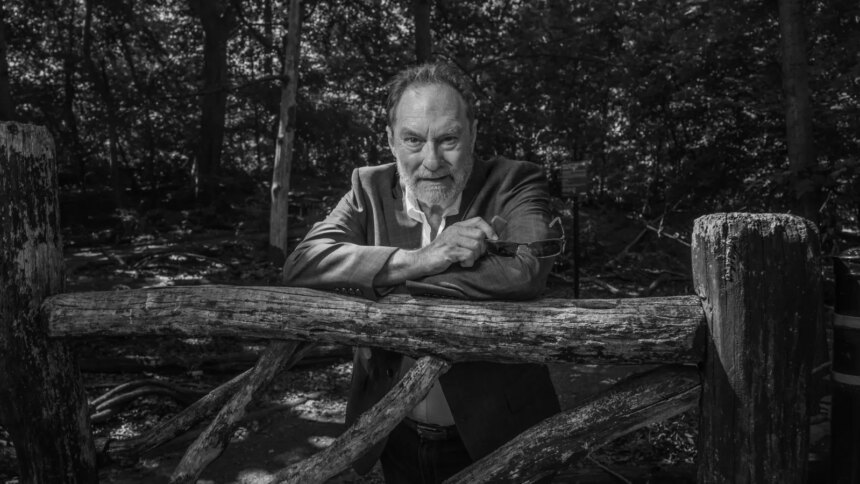
The city can make you feel small and expendable — much like a Stephen Root character. The remedy is finding laughter amongst the indignities. Fortunately, today we have the actor himself, giggling while watching a clip of himself as a Klingon. We’re sitting at a table at Gabriel’s off Central Park, not far from the pied-à-terre where he stays when in town. I’ve queued up several of my favorite Stephen Root scenes on my laptop. Currently we have Captain K’Vada, verbally jousting with Captain Jean-Luc Picard in a 1998 episode of Star Trek: The Next Generation. K’Vada (Root) is giving Picard (Patrick Stewart) a ride on his spacecraft to the planet Romulus so he can ascertain whether Spock has defected. (It’s the Star Trek world’s first ever crossover episode mixing the original and extra crispy cast).
K’Vada was an early career break for Root, although it’s hard to tell it’s him after three and a half hours in the makeup chair. Root didn’t mind the prep time, though — he grew up a sci-fi fan, his nose in books while his family moved from town to town.
“I loved it,” Root says with a smile. “I was such a geek. Brent Spiner [who played the android Data] was great — really sweet. He took me on the bridge, took pictures in the transporter. I called everyone I knew: ‘You’ll never guess what show I’m on.’”
In the scene, Stewart and Root, both Shakespeare veterans, are battling to see who can deliver their lines with the most gravitas.
Captain K’Vada: We have limited space. We are a military ship, not a pleasure craft.
Captain Jean-Luc Picard: Of course. This will be fine.
Captain K’Vada: You’ll sleep Klingon style. We do not soften our bodies by putting down a pad. [Pounds a hand down on bed.]
Captain Jean-Luc Picard: Good. [Also pounds a hand down on bed.] I prefer it that way.
Captain K’Vada: You’ll take your meals with us, but we do not serve Federation food.
Captain Jean-Luc Picard: Ah! I’ve been looking forward to gagh. Haven’t had it for quite a while. Very fresh!
Root laughs and rubs his eyes. When I ask if the two actors ever broke, he folds his arms and says, “If you don’t play it dead serious, you’re not going to get the comedy out of it.”
He pauses and imparts some wisdom, a quality in short supply in many of his characters.
“This is true in everything.”
ROOT RECENTLY WRAPPED the first season of Apple TV’s Widow’s Bay, one of the year’s best new shows. He plays Wyck, a grizzled sailor trying to convince Mayor Tom Loftis (Matthew Rhys) that opening the island to tourism is a catastrophic mistake.
Wyck feels instantly familiar. Not because Wyck is a Root repeat, but because the actor has spent four decades playing men who are overlooked, discarded, and possibly clinically depressed. There was Milton Waddams in Office Space, a constantly degraded cubicle drone who mumbles under his breath, “If they take my stapler then I’ll set the building on fire.” He’s played marginalized loners for brief moments in Coen Brothers movies, from O Brother, Where Art Thou? to The Ballad of Buster Scruggs, and for two decades on Mike Judge’s King of the Hill, specifically as Bill Dauterive, the saddest man on network television. More recently, he played Monroe Fuches, the amoral, not-so-bright, yet somewhat endearing manager of a psychotic assassin on Bill Hader’s Barry. That one won him an Emmy nomination.
Sometimes, you don’t notice Root’s moments on first watch because he is so embedded in the world he is passing through. Root appears on the screen, and you assume he has been there forever, like that forgotten couch in your parents’ basement. Still, you remember the characters long after the actual star’s performance has faded to black.
Wyck fits the bill. He is an angry old man who goes apeshit whenever he gets a whiff that Mayor Loftis is trying to make Widow’s Bay, a broken-down former whaling island off the coast of Massachusetts, the new Martha’s Vineyard. The show was created by Katie Dippold with five of the 10 episodes directed by Atlanta icon Hiro Murai. Dippold is a veteran of Parks and Recreation, and Widow’s Bay features some excellent workplace comedy bits with deadpan performances from Kate O’Flynn, Dale Dickey, and Jeff Hiller. Mostly, the show is an eccentric yet seamless mix of black humor and horror, with Wyck trying to convince Loftis that the island’s curses are real.

Root credits director Hiro Murai for letting the actors find great moments in Widow’s Bay.
Apple TV
Loftis has his own traumatic history with the town of Widow’s Bay, but remains skeptical until he is scratched by an ethereal creature on a foggy night. He drives over to see Wyck, who explains the curse of the Widow’s Bay sea hag.
But Wyck doesn’t just tell Loftis. Instead, he sings a sea shanty about sailors who disappear, never to be seen again, breaking every verse with a strange, vaguely indigenous-sounding “Ah-oo.”
Loftis, now terrified, has one question left for Wyck.
“I don’t understand, how do you die?”
Wyck stares down at the table before raising his eyes.
“She crawls into your bed and sits on your face.”
Balancing comedy and dread is a delicate thing; tilt either way and the moment becomes camp. Root’s chant scene was the first scene the cast shot, making it even trickier. Root deflects credit for its hilarity.
“Did you notice how much time Hiro gives Matthew to figure things out? The silences are crucial. Hiro knows how to set the tone.”
That’s part of it, but mostly it is because Root’s Wyck feels known from the first moment you see him. In a way, Root has been preparing to play Wyck his entire life. He was born in Florida, but his father built power plants for a living, so the family was constantly being transferred to cities like New Orleans and Kansas City. Root was always the new kid, not knowing who the jock was, or who was the bully. So he just kept his eyes open, taking notes.
“I identify as an internal nerd,” Root says. “Moving around, you don’t connect, but you become an incredible observer. I didn’t have close friends until junior year. You’re always on the outside looking in. I know these guys.”
I queue up another memory from the Coen Brothers’ The Ballad of Buster Scruggs, a series of Western vignettes put out by Netflix in 2018. A black-hatted James Franco strolls into the First Federal Trust Co. of Tucumcari; behind the counter, Root plays a bug‑eyed teller in a bow tie and green eyeshade. The teller babbles compulsively about past robberies, spilling details in a rush. He keeps babbling even after Franco pulls a gun on him.
“The Coens told me, ‘This guy talks to one person every five months,’” Root recalls. “So he has to get it all out fast. I asked, ‘Is this too big?’ They said, ‘No — more. Faster.’”
Franco’s character thinks he’s made a clean getaway when he hears a racket, and the teller emerges with a shotgun — clad in improvised armor of pots and pans. When a bullet from Franco ricochets off a pot, Root is exultant.
“Pan shot!”
Franco shoots again.
“Pan shot!”
And again.
“Pan shot!”
The teller clubs Franco and the scene fades to black.
Root shakes his head watching the mayhem. He sprained his ankle during an early take, stepping in a gopher hole. “They told me to run fast right at the camera, and I told them, ‘I’m going to run into him’ and I did.”
I mention that, like Milton in Office Space — who does, in fact, burn down the place — the teller got his moment of dark glory. Root relishes that fact.
“Yeah — isn’t that great?”
ROOT ATTENDED THE University of Florida in the early 1970s, dabbling in theatre, but left before graduating to hit the road with a traveling Shakespeare troupe that could be playing West Point one day and a community college the next. They were a happy few, so everyone had to double up on roles. Root did soliloquies and he also played maidens with balloon breasts.
He developed into a Broadway mainstay, highlighted by a role in a 1987 revival of Arthur Miller’s My Three Sons. By then, he had a kid and the need for a steadier income.
“You can’t sustain a kid on theater money, so we moved,” Root says, remembering the family’s trek to Hollywood. “I had to book immediately — we had rented a house in Woodland Hills.”
Root booked small parts in Ghost and Crocodile Dundee II. He was building momentum. Then, a big break: He scored a part with multiple scenes in Arnold Schwarzenegger’s Kindergarten Cop. It was a giant hit. Root does a great Schwarzenegger impression for me.
“One day I was sitting next to him in makeup,” he recalls, “and he looked over and said, ‘You’re fucking funny.’ I said, ‘Thank you, Ah-nold.’”

“I always want to find the humanity of the character,” Root says, “even if they’re an evil fuck.”
Sacha Lecca
There was just one problem. Root’s character was eliminated in the final edit. For an actor who would build a career playing overlooked men, it now feels like on-the-nose comedy. It did not seem funny at the time.
“I’m not a known commodity, not a name,” Root tells me. “So anything you get that has meat in it, in terms of real work in a movie, was rare. You’re doing your character-actor stuff, and if you don’t get a chance to be seen like the old character actors did in Thirties and Forties movies, then you kind of disappear.”
Root kept grinding, appearing as “Football Coach” on Party of Five and “Trumpet Playing Mental Patient” on Chicago Hope. He got his big break playing station owner Jimmy James on NewsRadio in a cast that included Dave Foley, Phil Hartman, and a fully-haired Joe Rogan. Sometimes in a comedy pilot, you can see an actor trying to find his way into the character. That’s not Root’s James; he nails his unearned bravado and comic insecurity from the first scene.
The show ran five seasons and gave him the financial security to try different things. During NewsRadio’s run, he got a call from Mike Judge to audition for a new show called King of the Hill.
“I think he saw me do a Southern character in a Civil War thing,” says Root. “There was a group of Southern actors on Broadway that I got to know well, and I could do that Southern thing.”
Root was so good that he scored two parts. One was Buck Strickland, Hank Hill’s philandering boss, who has many of LBJ’s characteristics including carrying on conversations while on the toilet. But it is his portrayal of Sgt. William “Bill” Fontaine de La Tour Dauterive that will live forever. Dauterive is a schlubby Army barber from Louisiana who still talks of Lenore, his ex-wife, in the present tense years after she left him. Bill has a particularly difficult time around the holidays. I cue up a Christmas episode where Bill is trying to be brave around his buddies and fails spectacularly.
“I do love Christmas. I like to celebrate the anniversary of when Lenore left me seven years ago, Christmas Eve. Best thing that ever happened to me. Yep.” He sobs and composes himself. “I tell you what, holidays are the least lonely time of the year.” He heads home, and Hank follows him and discovers Bill is wrapping presents. Hank asks him if the presents are for the long-departed Lenore. Bill stutters an affirmative response that captures every man who has held out irrational hope that a woman will return to him.
“I immediately knew Bill, because I’d worked with construction guys when I was working construction for my dad,” says Root. “I knew these guys who would, in their cowboy boots, just tuck in one pant leg, but not the other one, for no reason. The sadness is just from my other work. I think at the time I was playing a farmer that lost his wife and it stuck.”
Eventually, Root reached a point where he tried to steer away from his portrait of the American man as a dysfunctional lonely human. But they kept finding him, whether Office Space’s Milton or Gordon Pibb, the most average of the average Joes in Dodgeball: A True Underdog Story. He knew how to make these men feel real in five minutes onscreen, but he longed to work with one of them for an extended time.
That finally happened when he was cast as Monroe Fuches on Barry in 2018. Barry follows a depressed ex‑Marine hitman (Hader, in the title role) who turns to acting for salvation while tangling with the Chechen mob in Los Angeles. He repeatedly tries to leave the life behind but is pulled back in by his handler, Fuches — a parasite posing as a father figure. Fuches manipulates Barry with macho bluster, but he is a lonely man with no friends or moral compass.

As Milton in Office Space
© 20th Century Fox/Everett Collection

As Monroe Fuches in Barry
Merrick Morton/HBO
I call up the best episode of the show, the Ronny/Lily episode: A bloodied Barry tells Fuches he killed the target but then was attacked by his daughter and he won’t kill a child. Fuches has no such qualms. He binds up Barry’s open wound with superglue, then, in his overconfident way, tries to sweet‑talk the little girl on a suburban street as if she were a lost kitten.
“Hey, I don’t wanna sound like a creep, but do you wanna get in the car with me and my friend?”
She refuses and bounds from the driveway to a tree onto a roof in two moves. Night falls; they search for her. Lily slips into their car and bites Fuches on the face. Barry urges him to pull her off — but Fuches can’t: His hands are stuck to the steering wheel from the superglue. Lily breaks free with a chunk of his cheek in her mouth and runs. Fuches finally drops his macho bullshit and expresses the most human emotion: terror. He screams, “What are you?!”
Root smiles.
“I always want to find the humanity within the character, even if they’re an evil fuck.”
THIS BRINGS US BACK to Wyck. In a way, the character is the culmination of four decades of Root observation. Yet the actor had not planned to sign up for another potentially long-term gig so soon after Barry.
“I’m 74 now, and you sign up potentially for five to seven years on a show, so that was a lot,” says Root.
But he loved the part and the idea of working again with Murai,who directed him in Barry, and acting with Rhys, who he first worked with on the HBO reboot of Perry Mason. He is so enthusiastic about Wyck that he extends our time so he can tell me how wearing certain work boots puts him inside the character’s head. Root mentions another pivotal scene that he believes is the key to understanding another man who lives with regret.
It involves a teenage Wyck’s sailing misadventure, but it is nigh impossible to quote without spoiling the show. Let’s just say Root delivers one of the best monologues of his career, a soliloquy that somehow echoes both King Lear and Captain Quint in Jaws. You may weep. Then, a 300-year-old man shows up and there is farcical wrestling at sea. In other words, classic Root.
We head out into the bright Manhattan sunshine at lunch hour. Hundreds of tourists and residents brush by us. For 40 years, Root has built a career out of seeing people most of us overlook. Fittingly, not one passerby recognizes him.
Root doesn’t seem to mind. We shake hands and say goodbye. And then Hollywood’s everyman disappears, just another face in the crowd.