


Ben Solak
Multiple Authors
Development is not linear. It’s a truism, but it’s a valuable one in the NFL. Teams don’t always get better incrementally. If they did, the 4-13 Patriots wouldn’t have become the 14-3 Patriots in one short offseason. NFL players don’t get better incrementally, either. And even when they improve one season, they are not guaranteed to improve again the next year.
As such, it is a challenge to stand in one moment of time and say with certainty which players will continue to improve or continue to decline. The 2025 season was rife with risers and fallers. Later, we might call those same players one-hit wonders or flashes in the pan. But we might also call them bona fide stars and faces of the league. We just won’t know until we get there.
But from here, we can at least predict. I circled five players who suddenly broke out in 2025 and five players whose performance fell off a cliff out of nowhere to ask one simple question: Was it a blip or a trend? Is this player’s current arc destined to continue in 2026, or will his trajectory suddenly regress back to previous years — for better or worse — in the upcoming NFL season?
Jump to:
Breakouts | Cliff falls

Five 2025 breakouts

Perhaps no player is a more obvious 2025 “breakout” than Smith-Njigba, who went from productive young player in 2024 to league leader in receiving yards. Smith-Njigba didn’t just lead the league in receiving yards with 1,793 after posting 1,130 the year before. He did it without much cover from his teammates. He produced 44.1% of his team’s receiving yards — a simply preposterous centralization that we have not seen since 2012 Brandon Marshall.
I can craft the argument that Smith-Njigba’s 2025 is an unassailable trend simply with his yards per route run: 3.85, the second-best number of the past decade behind 2023 Tyreek Hill. Yards per route run is a particularly sticky stat. Looking at the top 20 players by yards per route run over the past 10 years, we mostly find repeat offenders. Guys at the top of this list tend to stay at the top, and those few one-hit wonders — players like Brandon Aiyuk and Michael Thomas — disappeared because of injury and unhappiness with their role.
One of the particularly cool things about Smith-Njigba’s emergence is how evidently faster he is from when he entered the league. Smith-Njigba passed on a 40-yard dash at the 2023 combine and instead ran at his pro day; his 4.52 seemed to detail an NFL slot receiver without much downfield ability. That’s how he was used at first, as 28% of his rookie targets came on screens under then-offensive coordinator Shane Waldron. Different times!
As Smith-Njigba’s route tree grew, so did the opportunity to show off his acceleration. Or perhaps it is a chicken-and-egg phenomenon, and the increased speed came first. Regardless, his average mph on routes has jumped from 13.5 to 13.7 to 14.2 over his three years in the pros, per NFL Next Gen Stats.
Listen to Fox commentator Tom Brady talk about Smith-Njigba’s routes. He highlights how Smith-Njigba’s body positioning never changes as he goes through his routes, which doesn’t tip his hand on whether he’s accelerating or decelerating.
“A lot of receivers, when they run if they’re speeding up or stopping, their shoulder plane will rise or fall. He maintains the same shoulder plane when he runs his route.”
🧠 @TomBrady breaks down what makes @jaxon_smith1‘s skillset so special. pic.twitter.com/vfJe7KgSS2
— FOX Sports: NFL (@NFLonFOX) January 26, 2026
This is a critical point. Smith-Njigba entered the league smooth as butter, and even as his play speed has increased, he isn’t playing at breakneck pace. It’s the control at this speed that has truly turned him into one of the league’s premier uncoverable threats, and it’s why he can line up anywhere and catch passes at all three levels of the field. Ja’Marr Chase is the elite tackle breaker. Justin Jefferson is an incredible route runner. Smith-Njigba’s ace is his play speed.
It’s almost inevitable that JSN’s numbers will take a dip as defenses focus more attention on him and dare just about anyone else to beat them. Offensive coordinator Klint Kubiak left Seattle to become the Las Vegas Raiders head coach this offseason, and new offensive coordinator Brian Fleury might not prove as adept at building the passing universe around Smith-Njigba. But even if the production does dip, I struggle to find any sound argument that Smith-Njigba will vanish back into the third tier of NFL receivers after the season we just saw.
Verdict: Trend forever, he’s perfect

Any list of breakout stars starts with a quick spin through big free agent signings. Contract-year players tend to explode, as their future earning potential is on the line. Perhaps no rising 2026 free agent made more money with his 2025 play than Lloyd, who had career bests in QB hits (10) and interceptions (five) in his first year under new defensive coordinator Anthony Campanile.
The book on Lloyd has always been that his length and explosiveness would give him sideline-to-sideline range. But that lightbulb never really came on as a true off-ball linebacker. So, Campanile instead lined Lloyd up on the line of scrimmage more (up from 8.0% in 2024 to 16.4% in 2025), at times flexing him off the edge into almost a nickelback alignment. This narrowed Lloyd’s vision — he didn’t have to read and react to nearly as many post-snap keys — and let him play faster. The reimagined role also allowed him to blitz more, and he excels there.
Lloyd certainly played with better physicality last season, but his breakout 2025 seems more related to his role than his actual improvement. After he spent four seasons with the Jaguars, the Panthers gave $45 million over three years to Lloyd, and defensive coordinator Ejiro Evero now needs him to be a three-down, off-ball linebacker that makes those sideline-to-sideline plays. Carolina does not have the depth at linebacker to specialize Lloyd’s role the way Jacksonville did.
As such, I think Lloyd’s 2025 — which included five of his nine career INTs — was a blip. But, as 2025 proved for Lloyd, a shrewd defensive coach can quickly uncover more promising play from an underdeveloped linebacker. The league, in general, is discovering that linebackers are very scheme- and usage-specific. The Eagles’ Zack Baun and the Rams’ Nate Landman both had bottom-of-the-roster contracts but became every-down starters. Baun specifically thrived in a hybrid on-/off-ball role in the Vic Fangio defense … from whom Evero learned how to coach defense. Could a similar job be available for Lloyd?
Lloyd played better in 2025, but not as well as his production would indicate. This is a blip year — and it won’t be the only one at the top of the linebacker market, as recent big contracts are aging poorly at this changing position.
Verdict: Blip

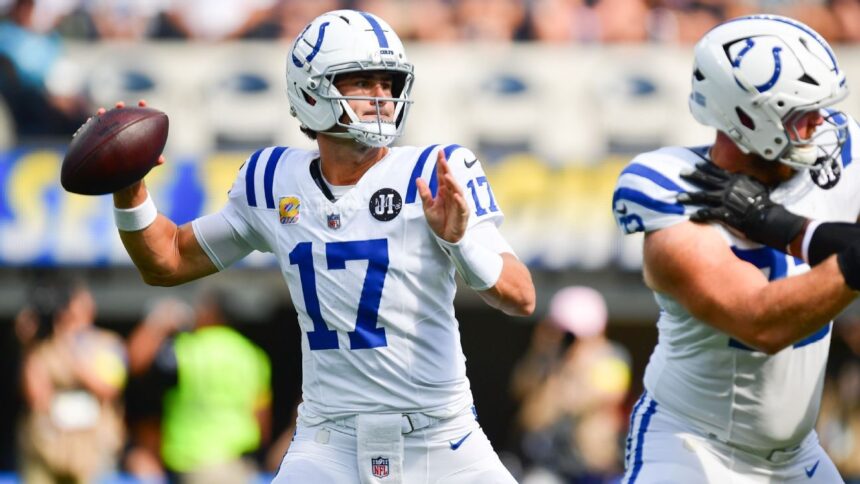
Had Jones finished the 2025 season, his “blip or trend” debate would have been a featured piece of offseason discourse. But we didn’t get the full picture.
Jones came out the gates hot — just a blistering pace. Through the first seven games, he led the league in dropback success rate (56.1%) and EPA per dropback (0.30), with a cool 71.0% completion percentage and 7.9 yards per dropback. It’s not just that the Colts and coach Shane Steichen had built around a midtier quarterback the way previous schemers had done — they were just doing it better than any QB reclamation had gone before.
Most preposterous — and least sustainable — of Jones’ many achievements over this stretch was his play under pressure. Statistical performance under pressure is notoriously volatile, and through seven weeks, Jones led the league in EPA per dropback when pressured. This was not really commensurate with his play over the previous six seasons with the Giants, when pressure tended to make him fold. In particular, Jones was avoiding sacks at an absurd clip. He had a pressure-to-sack ratio of 8.6% after averaging 23.3% over his career with the Giants.
As the clock struck midnight and the carriage became a pumpkin, Jones’ pressure-to-sack ratio shot back up. In the middle of the season, Jones began taking bad sacks against the Titans (33.3%), Steelers (27.8%) and Falcons (43.8%). Would Jones and the Colts have a counterpunch? Could Steichen get the ball out of Jones’ hand faster? Would Indy scheme up more protection to maintain its thriving play-action game?
We never found out. Jones fractured his fibula before the Week 12 game against the Chiefs, then popped his Achilles in Week 14 against the Jaguars, ending his season. If a solution was lurking under the surface, Steichen and Jones never had the chance to debut it.
Jones’ 2025 is obviously a blip. He was not just singularly productive for his baseline but also historically productive among league passers. The undressing of that charade was well underway before he got hurt. The awful reality that he must now recover from an Achilles injury makes the bet that 2025 was a peak season even easier to make.
With that said, for as blippy as this blip is … Jones was never coached well in New York, and his immediate comfort in Steichen’s offense is notable. He’ll never again achieve those 2025 highs, but could he give the Colts what the Buccaneers have gotten from Baker Mayfield? I believe so. Should he rush back from the Achilles for fear of losing his opportunity in Indianapolis, he might put his entire career in jeopardy. But if he comes back healthy, he has proved he can do enough good to stoke a roaring Colts offense. And that should not be discounted entirely.
Verdict: Super blip

I don’t know how much coverage the Dolphins’ starting center is going to get during the 3-14 season they’re about to produce in South Florida. But he belongs here, and he deserves flowers for what he pulled off in 2025.
The recently-extended Brewer was the single most impactful offensive lineman last season. That isn’t hindsight through his new deal — he would have been my vote for Protector of the Year. In former coach Mike McDaniel’s highly diverse running scheme, Brewer was featured as a puller and climber, similarly to how a fullback might be utilized as a lead blocker or in-space centerpiece. The Dolphins’ running game produced the highest explosive play rate on designed RB carries last season (by a big margin!) thanks in large part to Brewer’s ability to tag linebackers and safeties with shocking consistency.
watch center Aaron Brewer pic.twitter.com/ryYFKYWBi9
— Benjamin Solak (@BenjaminSolak) December 8, 2025
It’s a trite comparison, but Brewer was doing Jason Kelce-esque things in Miami’s running game last season. That’s how central he was to design and how consistent he was making blocks outside the numbers. And like Kelce, Brewer held his own in pass protection despite playing lighter than most centers. As McDaniel leaves Miami, Brewer’s anchor in pass protection will really get tested; McDaniel would hide him with pulls that concealed him from heavy-handed defensive tackles 30-plus pounds his superior.
Brewer’s breakout is quite the story. An undrafted free agent out of Texas State, Brewer fought his way into a starting guard spot with the Titans, and he moved to center one year before he hit free agency. Brewer’s blossoming at center is thanks in large part to his time with McDaniel, a uniquely gifted run game coordinator. There are serious “blip” worries with new offensive coordinator Bobby Slowik, as he might not be able to maximize Brewer the way McDaniel did.
Still, it’s difficult for a center this springy and balanced to not create splash plays in the running game. Slowik and McDaniel share San Francisco DNA from their time under Kyle Shanahan, and Slowik will major in a zone running game that serves Brewer’s lighter frame and quick feet well. Also on Miami’s offensive coaching staff is Kevin Patullo, who watched the twilight of Kelce’s career in Philadelphia.
There’s enough here in the current staff and construction of the Dolphins’ offense that I trust Brewer’s scheme fit for 2026 and beyond. A big extension certainly indicates the team plans on building around him for the next few years. This is a player trending up, even if he doesn’t make the All-Pro list every year at center moving forward.
Verdict: Trend

Man, was Pickens good last season.
We’ve thought Pickens could be good for a while. There were enough performances here and there with the Steelers to always create offseason hype for his upcoming ascension. But Pickens was never consistent in Pittsburgh. There were plenty of reasons for that, of course. A vast majority of his targets came from Kenny Pickett, and those that didn’t were from Russell Wilson, Mitchell Trubisky or Justin Fields. He simply did not play with a solid starting quarterback over three years with the Steelers.
Still, he was so explosive. Thirty-five percent of Pickens’ receptions went for 20-plus yards as a rookie, and another 29% did as a sophomore. It wasn’t even that he was used particularly far downfield — he averaged 13.4 air yards per target with Pittsburgh, and that only dropped to 11.5 with the Cowboys. It’s that he always seemed capable of turning a reception into a huge catch-and-run or snagging an inaccurate downfield target against seemingly impossible odds.
With the Cowboys, he seemed destined to fill a low-volume, field-stretching role beside target-hog CeeDee Lamb. That did not happen at all. Pickens indeed ran more vertical routes (47.4%) than he did with the Steelers (44.4%) … but his production wasn’t nearly as reliant on deep balls. He had 1.4 yards per route in Dallas after 2.8 in Pittsburgh. He was stretching the field, yes … but when he was targeted, he was targeted far more imaginatively.
Pickens went from a 47.3% successful reception rate — that’s the percentage of his targets that generated positive EPA for the offense — to 63.0% in one year with the Cowboys. Only Kayshon Boutte, Puka Nacua and Stefon Diggs had higher successful reception rates in 2025. Fifty-three percent of Pickens’ targets went for a first down or touchdown, up from 39% with the Steelers. Only Boutte was better among league receivers.
2:18
Is Stephen A. buying that George Pickens is bought in right now?
Dak Prescott‘s competency showed us that while Pickens remains a highly explosive height/weight/speed threat on the outside, he has more than enough route-running chops and QB friendliness to work the intermediate areas of the field. Pickens actually spent half as much time in the slot with the Cowboys (10% of his routes) than he did with the Steelers (20%). He was a traditional, dominant X receiver for Dallas — one of the rarest things left in the modern, versatile NFL.
It’s tempting to call Pickens’ 2025 a trend with a full chest’s worth of confidence. The hangup is that Pickens is an inherently mercurial player. He gets frustrated easily, plays too physically, has mental lapses and invites penalties. He’s on the franchise tag in Dallas, and after a season in which he comfortably outplayed Lamb (who is secured on a massive deal), it does not feel like his contractual angst will dissipate anytime soon.
Still, it’s a trend for sure, and smart teams should be trying to trade for Pickens’ tagged contract and extend him before the July 15 deadline. The talent is worth it, and the risk that comes with it is palatable. Not small, but palatable.
Verdict: Trend
Five 2025 cliff falls

The 2025 season might have been the worst of Tagovailoa’s career. By dropback success rate, he never had a less effective season, finishing at 45.6% after clearing 50% in all three previous seasons under Mike McDaniel. He never had a higher single-season sack rate (7.1%) or a higher single-season interception rate (3.5%).
To ask if Tagovailoa’s 2025 season was a blip or a trend, we have to first wonder how much of his previous offensive success was a blip itself. Tagovailoa’s efficiency shot through the ceiling in 2022 under McDaniel, who had sculpted a perfect offense to highlight his strengths — the quick release, the willingness to throw accurate balls into tight coverage — and conceal his weaknesses.
But that was a blip. It’s hard to sustain an explosive passing game when the quarterback lacks strong downfield accuracy given modest arm strength. And it’s hard, if not impossible, to get the ball out fast enough that a quarterback’s size and comfort through contact never factors in. At its peak, McDaniel’s offense was getting the ball out in under 2.5 seconds on 62% of Tagovailoa’s throws (the league average is around 44%). McDaniel and Tagovailoa both did their jobs, but it’s hard to keep that schematic edge so keen — especially after Tyreek Hill got hurt. The offense fell off a cliff in 2025.
Tagovailoa and McDaniel have both been cast out of Miami, and Tagovailoa landed in Atlanta, where he will compete with incumbent Michael Penix Jr. for the starting job under new head coach Kevin Stefanski. Although Tagovailoa has been in the league twice as long (six years) as Penix, he’s only two years older. The environment in Atlanta is strong: RB Bijan Robinson, WR Drake London and TE Kyle Pitts Sr. form a versatile trio of talented pass catchers. So, Tagovailoa has a legitimate chance to not just win the starting job but also play well enough to secure it for multiple seasons.
Stefanski runs a dramatically different offense than McDaniel did for Tagovailoa, with long under-center dropbacks on play-action fakes. But his offense is not particularly vertical, and it will not demand that Tagovailoa make big throws 20-plus yards downfield or outside of the numbers — where his arm struggles to deliver consistently. Over the past two seasons with Deshaun Watson (2024) and Dillon Gabriel (2025), Stefanski showed a willingness to get in the shotgun more, get the ball out quicker and sprinkle in some RPOs. That can work for Tagovailoa.
I still think 2025 is more trend than blip for Tagovailoa; he’ll continue to produce more modest numbers outside of the McDaniel offense than he ever produced in it. However, he has enough positive traits that good offensive coaches should get passable starting play out of him — and Stefanski is a good offensive coach. For as dramatic a fall as Tagovailoa suffered statistically in 2025, he can rebound nicely in 2026. He’ll never be the sort of player who escapes sacks or creates outside of structure; he’ll also continue to throw some brutal interceptions. But he can be a sufficient point guard in a well-built offense.
Verdict: Trend, but not too bad of one

Count me among those who were very bullish on Thomas for 2025. When I reviewed Thomas’ rookie season last summer, here’s what I wrote: “If we redrafted the 2024 draft tomorrow, I’d pretty comfortably take Thomas as the first receiver off the board. He has prototypical size, atypical speed and far more advanced technical skills than I gave him credit for during last season. I think we’re going to talk about him as a perennial top-five receiver — the way we talk about [Ja’Marr] Chase and [Justin] Jefferson — within the next two or three years.”
So close! Instead, Thomas turned an 87-catch, 1,282-yard rookie season into a 48-catch, 707-yard sophomore campaign. He did miss three games due to injury, but on a per-route basis, Thomas was a different player. He averaged 2.6 yards per route run in 2024, then 1.6 in 2025. His target rate fell from 27% to 21%. And even more precipitously, his catch rate fell from 65% to 52%.
The catch rate fell for two reasons. The first is obvious: drops. Thomas had six drops on 91 targets last season, good for a 6.6% drop rate — twice the average (3.3%) for high-volume wide receivers in 2025.
Drops are not a particularly sticky stat, so it’d be nice to wave 2025 away as a blip. But the other reason Thomas’ catch rate fell so much is his usage further downfield in 2025 — his average target depth was 14.4 yards relative to 11.3 in his rookie season. As the year went on, Thomas was used less as a three-level threat and more as a field stretcher, especially as players such as Parker Washington and Jakobi Meyers broke onto the scene as more reliable intermediate targets.
Thomas’ drops were overwhelmingly on the in-breaking routes you’d expect a big-bodied X receiver to feast on in the Sean McVay-inspired Liam Coen offense. On throws between the numbers, Thomas had a catch rate of 48.4%, fifth worst among high-volume receivers and a huge plummet from his 79.4% as a rookie. Of his six drops, five came between the numbers for a drop rate of 16.1%, worst of all receivers.
The Jaguars have clearly pivoted away from the idea of Thomas as their primary option on crossing and in-breaking routes. That’s where Meyers, a midseason trade acquisition who quickly received a multiyear extension, eats. It’s also an area for slot maven Washington in three-receiver sets, which the Jaguars might not even run as much after investing in second-round tight end Nate Boerkircher to play beside Brenton Strange.
What Thomas has is speed, and size to go with that speed. For as uncomfortable as he can be around hits in the middle of the field, he seems far more fearless when elevating for above-the-rim snags downfield. Thomas’ details on his breaking routes remain a work in progress, and miscommunications between him and quarterback Trevor Lawrence led to some of the between-the-numbers inaccuracy. But his ability to decelerate at his size is special and gives him plenty of separation on comebacks and back-shoulder fades.
If Thomas ends up relegated to a DK Metcalf-esque role — mostly outside snaps with a limited route tree — it will be a disappointment relative to our expectations for him coming out of 2024. But in an offense that likes to push the ball, and with his blend of size and speed, he can thrive in that role. And perhaps he can regain some of his rookie confidence on those routes across the middle.
Verdict: Trend

It’s difficult to exaggerate just how badly Smith fell off last season with the Raiders. From 2022 to 2024 — his three seasons as a starter in Seattle — Smith was 13th among 48 quarterbacks in dropback success rate. He was also 14th in yards per dropback, 14th in explosive pass rate and 19th in EPA per dropback. There were acceptable quibbles about his willingness to accept negative plays — too many picks, too many sacks. But he was a solid starting quarterback.
Among 38 qualified quarterbacks last season, Smith was 31st in dropback success rate, 35th in yards per dropback, 33rd in explosive pass rate and 33rd in EPA per dropback. The poor play could not have reared its ugly head more violently. He was 35th in interception rate and 38th in sack rate at a whopping 10.6%.
What happened? At 35 years old, it’s clear Smith has lost some of the juice in his arm. On throws 20-plus yards downfield, he had a 9.8% interception rate and only a 36.6% completion percentage. This was an area in which Smith shredded with the Seahawks over his whole tenure: seventh in completion percentage and fourth in off-target percentage.
Similarly, while Smith was never a particularly dangerous dual-threat quarterback, he had enough explosiveness in a thick frame to survive contact in the pocket. He wasn’t pressured any more in Las Vegas (37.2% of dropbacks) as he was in three years with the Seahawks (37.5%), but his pressure-to-sack ratio tailed off dramatically. With the Raiders, 28.4% of Smith’s pressures ended in sacks; with the Seahawks, it was 18.2%.
A diminished ability to escape pressure and hit downfield windows is the destiny of all aging quarterbacks. So Smith’s future as a serviceable starter is contingent on his ability to play more within himself. He has never been one to rush to the checkdown or quickly get the ball to a catch-and-run target, but older QBs need to let the offense work for them.
It’s worth remarking that Smith actually did embrace this change with the Raiders. Of his meager 3,025 passing yards, 56% came after the catch — a huge leap from his 46% with the Seahawks. He threw between 0 and 9 yards downfield 74% of the time in another jump from his Seattle days (70%).
The issue in Las Vegas was in the offensive design, as Chip Kelly’s second foray into the NFL proved an even quicker flameout than his first. The Raiders also couldn’t run the ball well, so they couldn’t get to third-and-manageable or force opposing defenses into base personnel. And when Smith pushed the ball downfield (20-plus yards), they lacked quality vertical receivers. Smith generated 11.4 EPA on 15 downfield targets to Tre Tucker and minus-0.03 EPA on 26 targets to everyone else. Brock Bowers and Jakobi Meyers are not deep threats, and Dont’e Thornton Jr.’s early push into the starting lineup was a disaster.
Even with Smith’s diminishing physical tool kit, I can talk myself into 2025 as a blip. Smith, like Tagovailoa, likely will not be among the league leaders in interception and sack rate again — those stats just have too much noise. But in a Frank Reich offense, I’m not expecting much more creativity than we got from Kelly in 2025. With Garrett Wilson once again stranded atop a thin Jets receiver room, it’s tough to find the downfield winners who will pay Smith off for his aggression. Smith could play better than he did with the Raiders and still suffer much the same season. Only a strong running game and breakout season from tight end Kenyon Sadiq would allow him to play more within himself.
Of course, 35 years old is still 35 years old. If Smith regains his Seattle-era productivity, it won’t likely be for long. But I believe he can.
Verdict: Blip, but close to becoming a trend. A blend, some would say.

Reports of Stroud’s cliff falling have been greatly exaggerated. After the Texans extended fellow 2023 draftee Will Anderson Jr. with a top-of-market deal as soon as he was extension-eligible, eyes immediately turned to Stroud. Why haven’t the Texans extended him? Do they doubt his long-term future as a starting quarterback? Would they explore moving him?
Anderson is one of the three best players at his position. He plays a premium position, has been largely healthy and is coming off a career year. Stroud is one of the 15 best players at his position. He plays a premium position and has been largely healthy … but he’s not coming off a career year. Unlike Anderson, who was always going to sign an extension at the top of the edge rusher market, Stroud won’t ink a deal at Patrick Mahomes’ $64 million APY. With a much larger range and a much bigger overall cost come more considerations for a contract’s structure and timing.
I know I just said Stroud is not coming off a career year, and it’s true that his rookie season was better. But not by much. Stroud’s atrocious postseason run spoiled the national perspective on his talent, but by the numbers, his 2025 and 2023 seasons are fairly comparable in many key metrics — save for explosive play rate.
The Stroud we all remember so fondly was a flamethrowing rookie passer in a Kyle Shanahan-inspired offense. Offensive coordinator Bobby Slowik put heavy personnel and condensed sets on the field to bluff run-action and force predictable coverages. Stroud saw base defense on 25.6% of his dropbacks as a rookie in 2023. That rate led the league and was why his explosive pass rate was so strong.
Once defenses got wise to the fact that Stroud was the primary danger to address in Houston, they changed how they played the team. Stroud saw much less base defense (17.7% of dropbacks) and a significant uptick in two-high shells (51.7% as a sophomore versus 45.7% as a rookie). Slowik struggled to find answers to the defensive shift, and he was replaced by Nick Caley, who has found more success in forcing base defense and single-high coverages for Stroud to attack.
But the running game is still a big issue in Houston’s offense. Since Stroud entered the league, the Texans are 31st in rushing success rate and 31st in EPA per rush. He has played in an entirely unbalanced offense — one asking the dropback game to bail out the designed running game, instead of using the modern method of a successful rushing attack to disguise and enhance the play-action passing game. Stroud has averaged 5.9 third-and-long dropbacks per game in the past two seasons, second only to Caleb Williams. He’s playing the game on hard mode.
None of this neatly explains Stroud’s total collapse in the playoffs, nor does it guarantee improvement. The Texans have added some help to their offensive line (Wyatt Teller, Braden Smith and Keylan Rutledge) and running backds room (David Montgomery), but they must prove they can grind out a good rushing attack before Stroud’s burden will be lifted.
Even if that’s achieved, Stroud will need a strong postseason performance to wash the taste of 2025’s disaster class from everyone’s mouth. But we don’t need to act like we’ve never seen Stroud in the playoffs before. He has made the divisional round in three straight seasons. In his four postseason games prior to 2025, he averaged 0.02 EPA per dropback and a 43.4% success rate. He wasn’t perfect, but he was just fine. To call him a snakebitten playoff choker is an easily disproven exaggeration.
Verdict: Blip

Brown was finally traded to the Patriots earlier this month, and that trade has invited scrutiny of his final season with the Eagles. This scrutiny is entirely fair, as he had the worst season of his career by yards per route run (2.1), EPA per route (0.05), first down rate per route (9.9%) and explosive reception rate per route (5.5%). Perhaps most notable was how often he seemed unable to separate, as 30.6% of Brown’s targets last season were to tight windows by NFL Next Gen Stats’ numbers, which is his worst mark since his rookie year.
The health of Brown’s right knee was highlighted as a long-term concern for some teams in the trading process. He has sustained nicks to his knee and hamstring in the past couple of seasons, and some of his Next Gen Stats tracking data is concerning. Brown hit 18-plus mph on only 14 routes last season, a career low. His max speed of 19.6 mph was also a career low, and this is the second consecutive season in which he has set a new low. Only 26.7% of his yards came after the catch, his worst mark in four seasons with the Eagles.
Of course, the easy explanation is that Brown was evidently disengaged from the Eagles’ offense last season. For whatever frustrations he harbored with quarterback Jalen Hurts or offensive coordinator Kevin Patullo, Brown was often caught dogging routes and had a couple of brutal drops across the regular season and playoffs. Even if Brown, who turns 29 later this month, has lost a step relative to his game in his early 20s, it’s fair to expect him to play at a faster clip in New England now that he has something to prove with a rising star QB in Drake Maye and a far more experienced playcaller in Josh McDaniels.
1:29
Why Marcus Spears loves Patriots trading for A.J. Brown
From a more general perspective, it’s easy to argue that Brown’s 2025 was a blip for that same reason. Professional athletes are all experts at converting perceived slights and doubts into impassioned performances. How often have playoff victors hollered “everyone doubted us!” after roughly 60% of experts picked against them? Perhaps no positional group on the football field is better at this conversion than wide receivers, who tend to engage much more with negative press and make statements with their play more than other players.
Brown also plays a style that will translate well enough as his body ages. Surely he was at his best as a dominant blend of size and speed, but size still works as speed declines. Brown averaged 2.2 yards of separation last season by Next Gen Stats’ numbers, but he has averaged only 2.4 yards of separation across his career. Meanwhile, he had a catch rate over expectation of 6.8% in 2025 — his third consecutive season of dominating the stat. Even if Brown’s devolution into a contested catch artist is inevitable — something I don’t even believe in the slightest — he’ll probably still be pretty good at it.
Verdict: Blip