


Five films in, singling out your favorite “Toy Story” movie feels like the animated kiddie-fairy-tale equivalent of naming your favorite Beatles album. You might have one, but why choose? These movies now add up to a canon greater than the sum of their boisterously funny, deliriously inventive parts. The truth is that the “Toy Story” movies are all beautiful, all brilliant, all different, and they work all together now. They’re a vision — of childhood life and nostalgic tenderness, of jostling ego and maniacal slapstick fun, of pure moviemaking enchantment. On that score, if the original “Toy Story” (still my favorite) is “Meet the Beatles,” and “Toy Story 3” is “Sgt. Pepper,” the splendidly catchy and seductive “Toy Story 5” feels like “Abbey Road.” It’s a sublime summing up, a movie that reflects the whole series in its magic mirror, and (just maybe) a perfect ending.
As the “Toy Story” films have evolved over 30 years, what’s emerged as their grand and bittersweet theme is the notion of loss. The sadness of it, but also the inevitability of it (so perhaps it’s not as sad as we first think). The toys, like the perpetually quarrelsome Woody and Buzz or Jessie the cowgirl, who now takes center stage, have seen their boy and girl owners grow up and leave them behind. That makes the toys feel almost like parents now, watching their children go off into the world. The movies deal with the specter of obsolescence — but also its happy twin, rebirth.
Now, in “Toy Story 5,” a new theme emerges that’s hauntingly and movingly of its time: the disappearance of play. Bonnie (voiced by Scarlett Spears), who is 8, still plays with red-rope-haired Jessie (Joan Cusack) and her trusty steed, Bullseye (Alan Cumming). But she doesn’t seem able to make friends with the other kids in the neighborhood. Why not? Because no one plays with toys anymore. The kids are all on their screens now — an invasion of tech the movie portrays as having caused a paradigm shift in child relationships.
“The age of toys is over!” declares an ancient discarded toy in mopey misery. As if in defeat, Bonnie’s parents buy her a Lilypad, a talking kiddie tablet (voiced by Greta Lee) with a green frog frame. Bonnie quickly becomes addicted to it, discovering that by communicating with other kids online, she can make “friends” instantly. Within 15 minutes, she’s got a playdate. But as the film knows all too well (and as too many adults have forgotten), friends made through a technological connection aren’t the same as friends you share the same space with — the friends you truly play with.
What “Toy Story 5” is talking about is what’s known as imaginative play, and that’s not just an activity. It’s a whole dimension, a way for kids to take the universe that’s in their heads and extend it out into the world. When imaginative play happens in “Toy Story 5,” the film depicts it in high-comedy sequences of spangly fluorescent color, where the action is hilariously straight-from-a-child’s-brain.
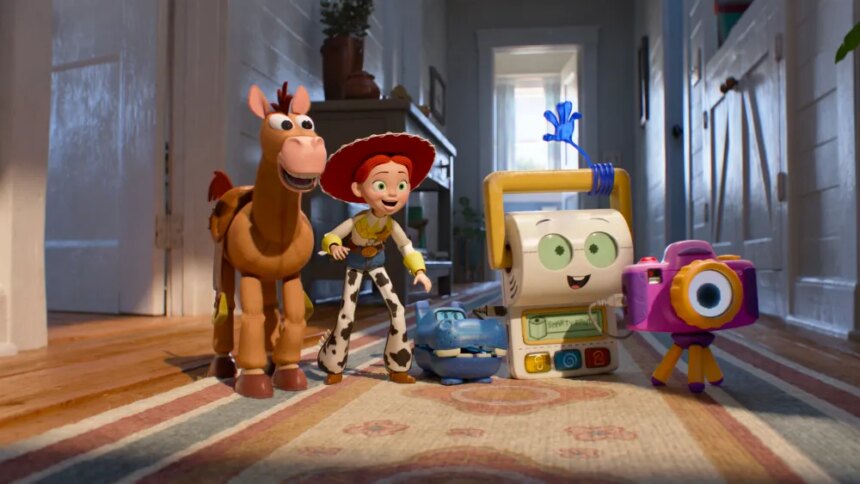
But the world isn’t organized to support this anymore. After a sleepover arranged via kiddie tablet, Bonnie’s new “friends,” who are like mean-girl 8-year-olds (a byproduct of the computer age), make fun of her for still clinging to her old toys. Jessie and Bullseye wind up back at the farmhouse where Jessie’s original child, Emily, once lived — and where there is now a 9-year-old named Blaze (Mykal-Michelle Harris). But pulling Bonnie back into the world of imaginative play will be no easy feat. It will take the machinations of Jessie and Woody (Tom Hanks), who’s now a balding “old man” cowboy; all our familiar old toy friends; a trio of primitive tech devices — a potty trainer named Smarty Pants (Conan O’Brien), a kiddie camera named Snappy (Shelby Rabara), and a GPS hippo named Atlas (Craig Robinson) — who are halfway between the analog and digital worlds; and an army of Buzz Lightyears stuck in demo mode, who have been massed into the Multi-Buzz, a fighting force overseen by their fearless leader (Tim Allen).
Andrew Stanton, the fabled Pixar director of “Wall-E,” now takes the reins of a “Toy Story” film for the first time (though he worked on all the others), and he’s made a movie with an ambitious and delicious layer-cake density. Where a lesser film would have made the story a battle between old-school good guys (toys) and new-school bad guy (screens), “Toy Story 5” doesn’t demonize tech life so much as depict it as a new metaphysical realm of the kiddie cosmos. The plot is elaborate, yet it all comes down to Jessie and her team trying to arrange for Bonnie and Blaze to have a playdate — because they’re girls who still have their heads in the real world. Joan Cusack, spouting out “ain’t” and “don’t” and lines like “Holy butterscotch!,” makes Jessie a gruffly infectious good ol’ girl. She’s got a romance going with Buzz (who’s dying to propose to her) that becomes touchingly funny. (When he flies in on a winged princess horse, we’re in “Toy Story” heaven.) Meanwhile, Hanks invests the vulnerable but stubborn Woody with a delectable senior resilience.
“Toy Story 5” escalates in delight (the climactic wedding ceremony must be seen to be believed), but it also has moments that hit you like a gut punch. For this is a movie that touches on a profound question: How will kids connect to each other in an era that wants them to grow up too fast by virtualizing themselves? The film’s message is: Slow down, be real and play. The fun you take is equal to the fun you make.