

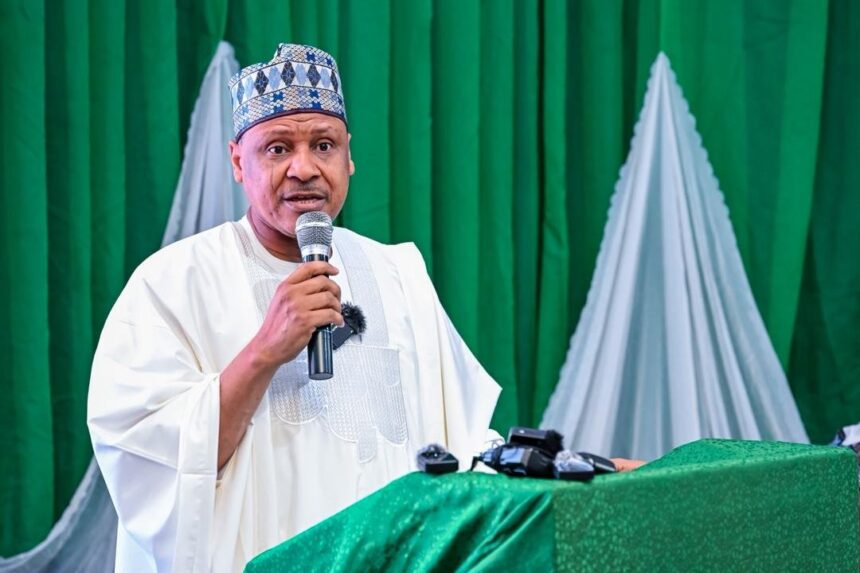

The Minister of Information and National Orientation, Mohammed Idris, has urged Nigerian media organisations to stop giving publicity to terrorists and other criminals, saying that excessive coverage of their activities serves the interests of those seeking to spread fear and instability.
Speaking at a security summit organised by the Nigerian Union of Journalists (NUJ) in collaboration with the State Security Services (SSS), popularly known as DSS, Mr Idris said journalists must balance press freedom with national responsibility in the interest of nation-building.
“Please take these terrorists and criminals off your front pages,” the minister said. “This is what they crave for free of charge.”
The summit will last for two days, with the SSS Director General expected to deliver a presentation on Friday. Those present during the first day of the event include officials of the International Press Institute (IPI) Nigeria, military and police officers, as well as representatives of Defence Minister Christopher Musa and Kano State Governor Abba Yusuf.
The information minister expressed concern that media reports often give prominence to the activities of terrorists, bandits and kidnappers while paying less attention to the efforts and sacrifices of security personnel working to protect lives and property.

“It saddens my mind. I feel very unhappy when I see our front pages, when I see our headlines, reporting the activities of these criminals and underplaying the ones by the security agencies,” he said.
According to Mr Idris, responsible journalism does not amount to censorship but requires media professionals to exercise sound judgment in determining what should be reported and how it should be presented.
He added that the best journalists are those who know “what not to report in the interest of nation-building.”
“Nobody is calling for censorship. Nobody is asking the media not to do its job, but we must know that we must have a country to keep. We must have our unity to uphold so that Nigeria can make progress,” he said.
The minister noted that Nigeria is facing increasingly complex security challenges, including terrorism, violent extremism, cybercrime, misinformation and organised crime, making collaboration between the media and security agencies more important than ever.
He stressed that both institutions have critical roles to play in nation-building, with security agencies responsible for protecting lives and national sovereignty, while the media serves as a watchdog and bridge between government and citizens.
Mr Idris also commended the improving relationship between journalists and security agencies, particularly the SSS, noting that the NUJ had reported no cases of journalists being arrested or detained by the agency in the last one and a half years.
He challenged other security agencies to maintain similar standards and expressed hope that incidents involving the detention of journalists would become a thing of the past.
The minister reaffirmed the federal government’s commitment to strengthening engagement between the media and security institutions through dialogue, strategic communication, capacity building and public enlightenment initiatives.
PREMIUM TIMES reports that Nigeria continues to grapple with multifaceted security threats, including the farmers–herders conflict, banditry, and insurgency. These threats are driven by a range of underlying factors, such as climate change, weak governance at the grassroots level, ethnic and religious tensions, and the spread of disinformation, among others.
READ ALSO: How Nigerian terrorists use TikTok, exploit country’s digital governance gap
In the North-east, the Boko Haram insurgency, which has now entered its 17th year, continues to escalate beyond its original hotbeds, which experts describe as the BAY (Borno, Adamawa and Yobe) states. The insurgency has mixed with banditry in North-central and North-west, where the Boko Haram franchise and some insurgent groups wage war in some communities in Niger, Kwara, Kebbi, and Sokoto states.
The crisis is now spreading southward with terror attacks reported in Kwara, Ondo and Oyo states.
Security agencies have also secured major wins against terror groups. In his latest Democracy Day speech, President Bola Tinubu said that over 13,000 terrorists have been killed and 124,000 others have surrendered. This data was first made public by the National Security Adviser (NSA), Nuhu Ribadu, during the All Progressives Congress (APC) summit to mark the second anniversary of Mr Tinubu in office.