

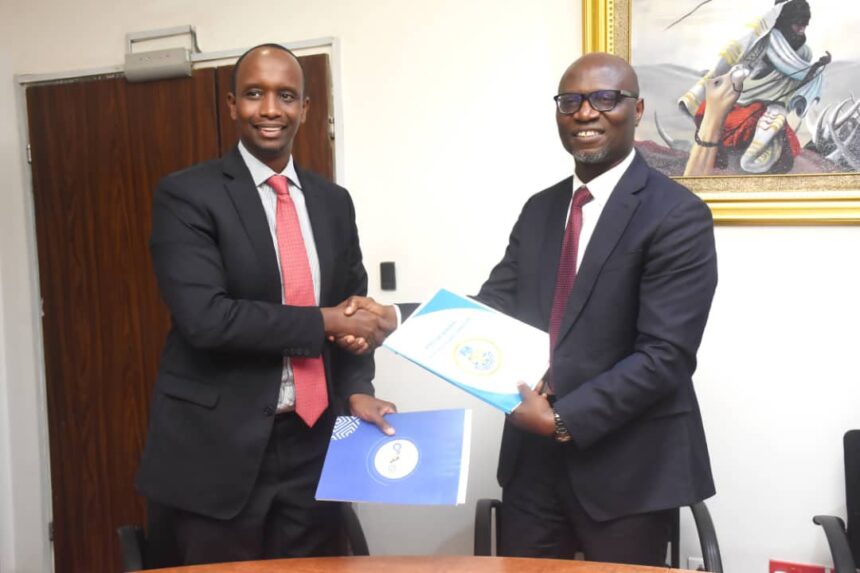
Nigeria’s Securities and Exchange Commission (SEC) has signed a Memorandum of Understanding (MoU) with Rwanda’s Capital Markets Authority (CMA), formalising a bilateral regulatory partnership aimed at strengthening capital market cooperation between both countries.
SEC disclosed in a release that the agreement was signed during a ceremony held in Abuja on Monday by SEC Director-General Dr. Emomotimi Agama and CMA Rwanda Chief Executive Officer Mr. Romeo Ngaranbe.
The partnership is expected to deepen cross-border investment opportunities, strengthen regulatory collaboration, and support the broader African capital markets integration agenda.
What they are saying:
Speaking at the signing ceremony, Agama described Nigeria as a willing partner in advancing African capital market development, urging countries across the continent to invest in one another’s markets and build a stronger financial ecosystem. He also stressed that long-term capital markets remain critical to financing Africa’s infrastructure needs.
- “We need to cooperate in Africa, invest in each other’s market and grow our continent. In so doing, we will build collaboration so that as Africans we can have a focus and build a strong interconnection. The time is now for us to look inwards.”
- “We encourage government to use long-term capital for long-term projects. The capital market is the solution to raising funds for long-term infrastructure development.”
- Rwanda CMA Chief Executive Officer, Romeo Ngaranbe, said: “We are here to learn from you as you have a more advanced capital market and we are sure we will gain some useful lessons that aided the development of your capital market.”
The SEC said the collaboration reflects a shared commitment by both regulators to strengthen Africa’s financial markets through closer cooperation and knowledge exchange.
More Insights:
Under the terms of the MoU, both regulators agreed to collaborate on investor education, capital market development, regulatory information sharing, capacity building, technical assistance, and cooperation on enforcement and supervisory matters.
- The agreement covers investor education and capital market development initiatives.
- It provides for the exchange of information on regulatory and market developments, alongside training and technical assistance.
- Both regulators also committed to cooperating on enforcement and supervisory matters of mutual interest.
The framework supports broader regional and international engagement to promote stronger regulatory alignment across African markets.
The agreement recognises that cross-border regulatory cooperation is essential for improving investor confidence, encouraging innovation, and promoting sound market practices. Nigeria’s NGX remains one of Africa’s largest exchanges by market capitalisation, while Rwanda’s capital market has continued to expand under the country’s economic transformation programme.
What you should know:
The SEC-Rwanda CMA agreement is the latest in a series of international regulatory partnerships being pursued by the Agama-led Commission to strengthen Nigeria’s position within African and global capital market governance.
- Nigeria’s SEC has signed similar cooperation agreements with regulators in Ghana, Egypt and South Africa as part of efforts to support the African Continental Free Trade Area (AfCFTA) financial services agenda.
- The partnership follows the enactment of the Investments and Securities Act 2025, which expanded the SEC’s regulatory powers and enhanced its ability to engage international counterparts.
- Rwanda has consistently ranked among Africa’s fastest-growing economies, supported by strong institutional governance and policies aimed at positioning Kigali as a regional financial hub.
The SEC said the partnership is designed as a mutual collaboration, with both regulators expected to work together on enforcement initiatives and investor education across their respective jurisdictions.
The latest agreement underscores Nigeria’s growing efforts to deepen regional financial integration while positioning its capital market as a key driver of long-term investment and economic development across Africa.