

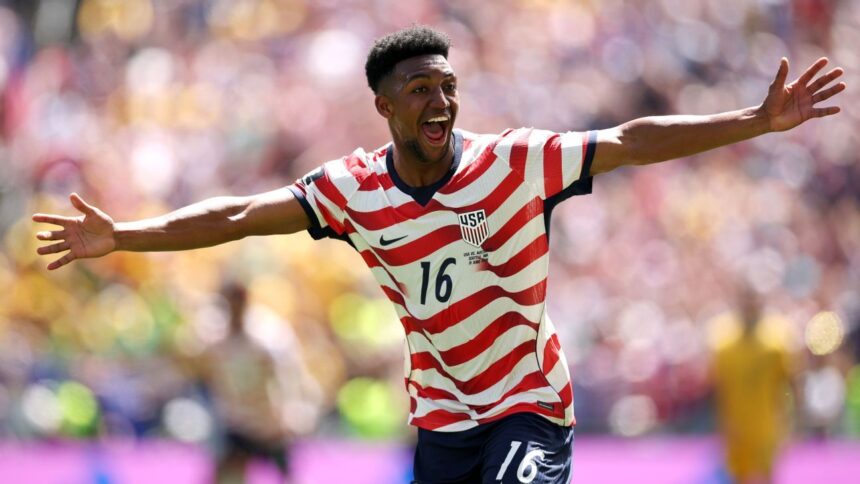
SEATTLE — The U.S. men’s national team made it two for two at the 2026 FIFA World Cup, defeating Australia 2-0 on Friday to advance to the knockout rounds and give it a stranglehold on the top spot in Group D. An own goal from Australia defender Cameron Burgess, after a scintillating run from Folarin Balogun, put the U.S. up in the 11th minute. Alex Freeman then doubled the advantage in the 43rd minute when he was first to a deflected shot and nodded the ball home.
The win was notable for the fact that the USMNT prevailed without attacker Christian Pulisic, who sat out the match with a calf injury.
The USMNT once again equaled some team marks. This is the first time the U.S. has won consecutive matches at a World Cup since 1930. That was also the last time the Americans scored two or more goals in the first half of consecutive World Cup matches.
The U.S. could even clinch the top spot in the group later in the day if Paraguay can manage to take points off of Türkiye.
As for the Socceroos, they are by no means out of the running for the knockout rounds. A win in their final match against Paraguay would give them six points, which should be more than enough to advance. — Jeff Carlisle
Pulisic sits, but the U.S. finds another way
The news that Pulisic would sit out the match arrived 90 minutes before kickoff. Given that Ricardo Pepi was selected as Pulisic’s replacement, a tactical tweak was expected as well. As it turned out, the U.S. operated in a similar manner. The U.S. still played with four in the back when defending, and three defenders when in attack, but the switch allowed the U.S. to use both Pepi and Balogun to press the Australia center backs and link up with wide players when in the possession.
“What I saw [was] a team that really believe in what it is doing with different plans and with different approach,” U.S. manager Mauricio Pochettino said after the match. He added, “I think that capacity to adapt to the different demands of the game, and also our demand, like a coaching staff planning, different approach on the games, I think only I can say good and fantastic things about my players. … They were fantastic.”
All told, the U.S. wasn’t quite as dynamic as it was against Paraguay with Pulisic on the field, but this was the day when the U.S. found different ways to be effective. Much was made of how Australia’s height at the back would make it difficult for the U.S. strikers, but there is no accounting for speed, which contributed to the first goal in the 11th minute. Balogun left Australia defender Alessandro Circati for dead on the left wing, reached the end line and watched his low centering feed get bundled into the net by Burgess.
Freeman’s goal wasn’t a thing of beauty either, and was aided by VAR, but by beating goalkeeper Patrick Beach to a loose ball after Sergiño Dest‘s shot was deflected high in the air, he showed how quick thinking and scrappiness could give the U.S. advantage.
Confidence is manufactured in all kinds of ways. Against Paraguay it was through dynamic play. Friday’s match showed how the U.S. could find a way to win other than relying on its star. With Pulisic expected to be back for the group stage finale, the USMNT will be flying high, and full of self-belief. — Carlisle
Passive Australia punished
In his pregame news conference, Pochettino spoke about his side needing to match the Australians’ level of belief if the Americans were going to compete. And, well, they did more than just match the Socceroos’ belief and mentality; they thoroughly outclassed it, as seemingly every second ball, every contest and every loose possession was won by the hosts in the first half.
“We didn’t match that in the first half,” Australia manager Tony Popovic said after the match. “We found it difficult to win a challenge, to win a second ball. We were slow to every ball, and we couldn’t really wrestle back any momentum, which made it difficult. And we considered a couple of soft goals, really for us, they were soft goals, but we just looked flat and lethargic in the first half.”
After their composed display against the Türkiye, the Socceroos never looked like they settled across the opening half and committed far too many unforced errors, as well as several further enforced ones under a rapid and intense American press.
In addition, the rotations, combination play and hard running of the Americans — even without Pulisic — dragged the Socceroos fullbacks out of position, and this allowed them to get in behind at a much greater rate than the Turks, as exemplified by Balogun streaking in behind ahead of Burgess’ unfortunate own goal. This was aided by the Australians playing a slightly higher line than last week, without gleaning much, if any, in the way of reward. They weren’t set up to counter the Americans.
If the win over Türkiye was Popovic’s Popaball at its best, this was it at its nadir. — Joey Lynch
USMNT presses its way to success
One question heading into the match was: Given how Australia are adept at hitting teams on the break, would the U.S. still dare to press the Socceroos and risk giving up transition opportunities? The answer was a resounding “yes.” It certainly did the U.S. no harm that Popovic decided to start the match with speedster Nestory Irankunda on the bench, but the hosts were still intent on playing their game, and succeeded in this regard.
This is where playing with two strikers had a benefit, in that it prevented the Australia center backs from hitting long passes.
“In the press conference [on Thursday, I said] that they don’t play long ball, they play long passes, and I think we forced them to play long,” Pochettino said. “And because in the way that the players are so good, I think the way that we work, starting with our two strikers then behind [with] Weston [McKennie], [Dest], Malik [Tillman], Tyler [Adams], Antonee [Robinson], and was a very good job and make easy to our defensive line.”
This wasn’t a day when the U.S. scored directly off of the press, but it helped the American cause in other ways. The tactic did plenty to disrupt the Socceroos’ buildup and helped put the game’s physicality — thought to be an advantage for Australia going in — on more even terms. To be clear, the tactic has its limits. No team can play that way for 90 minutes, and Australia piled forward in the game’s latter stages in a bid to climb back into the match.
The press has long been a hallmark of Pochettino-coached teams, but the concepts were slow to take root during the Argentine manager’s first year with the USMNT. Now they are apparent in everything the U.S. team does, and it has been a joy to watch. — Carlisle
Popovic gambles and loses on selections
For the second straight game, Popovic gambled with his starting XI, but while he was richly rewarded against Türkiye, he went bust against the U.S. Brought into the lineup in place of goal scorers Irankunda and Connor Metcalfe, neither Mathew Leckie nor Nishan Velupillay was able to have a significant impact on play, with the latter being hooked at halftime for Metcalfe and the former replaced on the hour mark by Cristian Volpato.
Both Volpato and Irankunda, who came on at halftime for Mohamed Touré and played as a No. 9, offered flashes of real potential after their entrance, and the team as a whole began to string a few things together late despite not exactly getting a favorable whistle. And while there’s an obvious disclaimer that they came on as the game stretched, this adds extra scrutiny to Popovic’s selections. Perhaps Volpato’s conditioning wasn’t at the level needed, but why bench Irankunda, especially when you may need an outlet against a high-pressing side?
Further, is Touré at 100%? The striker came out of the dressing room significantly later than the rest of his teammates after the break and looked quite ginger as he emerged. It’s a key question moving forward. — Lynch
Attackers get headlines, but Adams is indispensable
This was a day on which there were plenty of stars. Balogun once again showed his influence. Freeman popped up at the right time, and Chris Richards showed why his recovery from an ankle injury might be the single most important development of this World Cup for the USMNT. But the press works only because it has an absolute nuclear-powered engine in midfield with Adams.
To be clear, Adams is by no means on his own. Tillman, Dest and McKennie did their bit as well, but this was a day when the AFC Bournemouth midfielder was everywhere, making a team-high 14 defensive interventions.
Even on the rare occasion when Adams was beaten, he managed to recover and continue to frustrate his opponent. This provided a sizable shield in front of a backline that has shown some vulnerabilities in transition, which helped meet the physical challenge posted by Australia. Adams nearly got a World Cup assist when he released Balogun in the second half on a breakaway, only for the Socceroos defense to recover and block the shot.
1:56
Has Pochettino silenced the doubters?
At this stage, there are several indispensable players on the USMNT. Adams is certainly one of them. — Carlisle
Australia can’t recover from another slow start
Slow starts have become something of a theme for the Socceroos in recent times. They fell behind against Mexico at the Rose Bowl earlier in a pre-World Cup warmup last month and did so once more the following week against Switzerland.
The hope had been that last week’s win over Türkiye, in which Irankunda put them ahead early, signaled a change now that World Cup mode was being activated. Friday put that theory to bed.
Almost straight from the opening kickoff in Seattle, the U.S. was able to establish dominance, and though both of their goals might have been jammy, one couldn’t argue that either wasn’t deserved based on the balance of play. Under Popovic, the Australians are highly dependent on game state. They’re simply not built to chase deficits from behind, so going into the sheds down two goals, even if that was something of a silver lining given it easily could have been more, represented a hammer blow.
They cannot afford a slow start in a suddenly gigantic clash with Paraguay on Thursday. — Lynch