

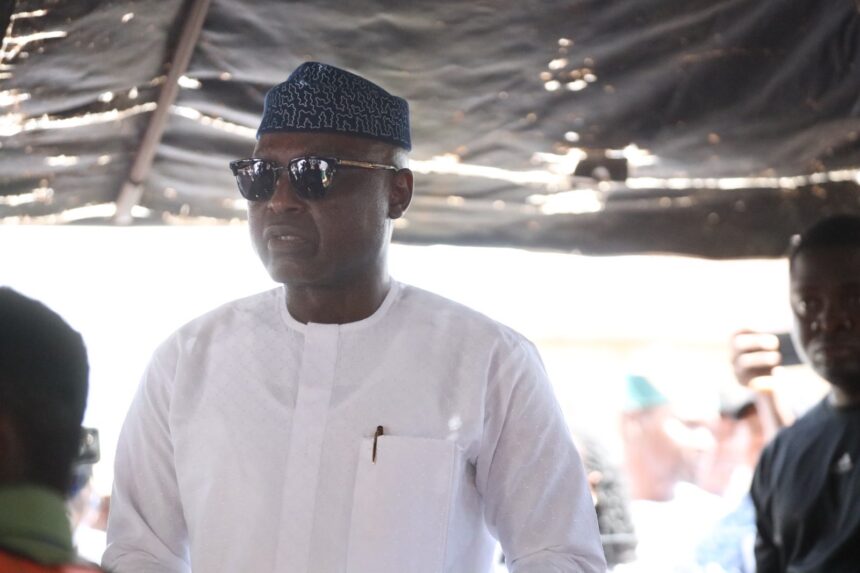

Governor Biodun Oyebanji of the All Progressives Congress (APC) has been re-elected as the governor of Ekiti State, overcoming a field of 13 challengers and reinforcing his political dominance in a state long known for its unpredictable electoral history.
The Independent National Electoral Commission (INEC) declared Mr Oyebanji the winner of Saturday’s governorship election after he secured the highest number of valid votes cast across the state’s 16 local government areas.
According to the results announced by the electoral commission, Mr Oyebanji polled 319,224 votes to defeat his closest rivals, Oluwole Oluyede of the Peoples Democratic Party with 40, 533 votes, and African Democratic Congress’s candidate, Dare Bejide with 2,872 votes.
The victory grants the governor another four-year term and makes him the first Ekiti governor to successfully secure consecutive re-election in a state where incumbents have often struggled to retain power.
Defying Ekiti’s political tradition
Since 1999, governorship elections in Ekiti State have frequently produced leadership changes, making the state one of Nigeria’s most competitive political battlegrounds.

Although former Governor Kayode Fayemi won a second term in 2018 after previously serving between 2010 and 2014, he did so after leaving office and returning through another election cycle rather than through immediate re-election as an incumbent.
Mr Oyebanji’s victory therefore stands out as a significant political achievement, especially given the intense contest mounted by opposition parties during the campaign period.
Political analysts had described the election as an important test of the APC’s popularity in the South-West ahead of the 2027 general elections.
Mr Oyebanji campaigned largely on continuity, highlighting achievements recorded during his first term in infrastructure development, education, healthcare, agriculture and investment promotion.
The governor emerged as the APC candidate through a consensus arrangement after his only challenger in the primary election withdrew and endorsed him.
Throughout the campaign, he repeatedly appealed to voters to support ongoing development projects and pledged to deepen economic growth and social welfare programmes if re-elected.
Opposition challenge
The election featured candidates from 13 other political parties.
Among the leading challengers were the PDP’s Oluyede and ADC’s candidate, Mr Bejide.
Other candidates included the flag bearers of the Labour Party, Accord Party, New Nigeria Peoples Party, Action Democratic Party, Action Alliance, Allied People’s Movement, Action Alliance Congress, People’s Redemption Party, Young Progressives Party, Zenith Labour Party, and Action Peoples Party.
Despite the crowded field, PREMIUM TIMES-monitored results showed the APC recording a strong lead across virtually all parts of the state.
While announcing the election result, INEC said it had accredited 384,940 of the 988,251 registered voters. Out of the 382,109 votes cast, the total valid votes in the election were 375, 777.
Election conduct
The election was conducted across 2,445 polling units in the state’s 16 local government areas under heavy security deployment.
Before the poll, political leaders, including President Bola Tinubu and Governor Oyebanji, had appealed to voters and party supporters to maintain peace and avoid violence.
INEC had also assured residents of adequate preparations, including the timely distribution of sensitive election materials and deployment of electoral personnel.
With the declaration of the results, attention is expected to shift to possible reactions from opposition parties and preparations for the governor’s second-term inauguration.
For Mr Oyebanji and the APC, however, the outcome represents not only another electoral victory but also a significant statement of political strength in a state where incumbency has not always guaranteed success at the polls.