

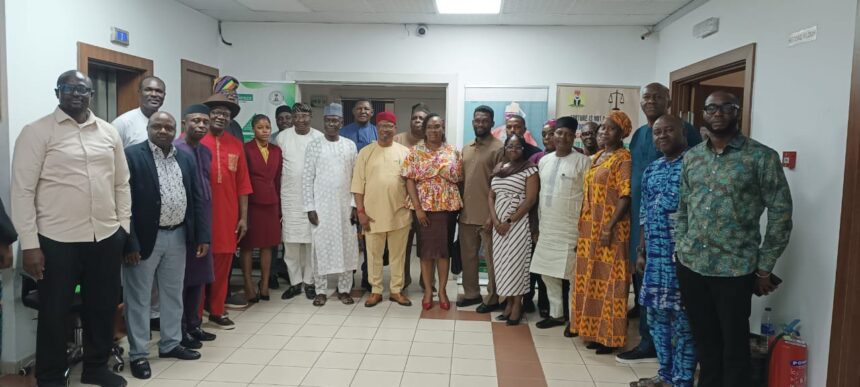
The Federal Government has moved to centralise Nigeria’s livestock data through the validation of the National Livestock Information Management System.
This was disclosed by the Permanent Secretary of the Federal Ministry of Livestock Development, Dr. Chinyere Ijeoma Akujobi, during a validation session in Abuja.
The platform is designed to strengthen data-driven decision-making, improve sector coordination, and support the sustainable transformation of Nigeria’s livestock industry.
Dr. Akujobi described the initiative as a major milestone in the Ministry’s efforts to build a modern, productive and globally competitive livestock sector.
What they are saying
Represented at the event by the Director of Planning, Research and Statistics, Stephen Ohaeri, the Permanent Secretary said one of the Ministry’s key priorities since its establishment has been to create the institutional framework needed to transform the livestock sector. She said the sector has the potential to support food security, employment generation and economic growth.
- “The National Livestock Information Management System was conceived to address these challenges by providing a centralised and integrated platform for livestock data collection, management, analysis and reporting,” she said.
- “The NLIMS is a strategic institutional tool that will support evidence-based policymaking, strengthen programme monitoring, enhance sector oversight and provide the reliable data required to guide investment decisions and measure impact across the livestock ecosystem.”
Dr. Akujobi noted that critical livestock information on animal populations, production systems, markets, animal health, value chains and sector performance remains fragmented across several sources, making effective planning and monitoring difficult.
Get up to speed
The validation exercise was aimed at reviewing the proposed architecture and prototype of the platform.
- Developers of the platform presented key features, including mobile and web-based data collection.
- The system will integrate with existing Ministry databases and allow automated data exchange with partner institutions.
- It also includes multi-layer validation mechanisms and centralised data warehousing.
- The platform is expected to aggregate information from field officers, state coordinators, Ministry departments, livestock associations, development partners and other relevant institutions.
According to the Ministry, this is to ensure that the system meets its operational needs and can support the long-term management of livestock information across the country. The Ministry said the goal is to create a single source of truth for livestock data in Nigeria.
More insights
The platform includes modules covering livestock population and production, markets and trade intelligence, infrastructure and services, institutional actors, planning and reporting, conflict management, and integrated animal identification and traceability systems.
- According to the developers, NLIMS will provide real-time access to critical information needed across the livestock value chain.
- The system is expected to support policy formulation and programme implementation. It will also help with resource allocation and investment planning.
- The platform will improve performance monitoring across the livestock ecosystem.
- The validation session included a live demonstration of how data can be collected, validated, approved and converted into actionable intelligence.
Participants expressed optimism that successful deployment of the platform would improve data governance, strengthen institutional coordination and enhance the Ministry’s ability to deliver on its mandate.
The centralisation of livestock data is expected to improve planning and oversight in a sector where information has often been scattered across multiple institutions and stakeholder groups.
A unified platform could also help policymakers track sector performance more effectively and make better investment decisions.
This means the Ministry will be better positioned to use reliable data in addressing gaps across production, markets, animal health, infrastructure and sector development.
What you should know
Earlier this year, the Federal Government announced plans to reform Nigeria’s livestock export framework. The market was estimated at $3.2 billion.
The Head of Press and Public Relations at the Ministry of Livestock Development, Oghenekevwe Uchechukwu, disclosed this while responding to inquiries from Nairametrics.
- The response followed a recommendation by the United States Congress to block Nigeria’s beef and cattle exports to Ivory Coast, Ghana, South Africa and Senegal.
- The recommendation was part of proposed measures to disarm Fulani militias allegedly involved in violence against Christians.
- The livestock export reform plan forms part of broader efforts to reposition the sector for growth and improved market access.
The latest validation of NLIMS adds another layer to the government’s ongoing efforts to modernise Nigeria’s livestock industry and improve institutional coordination.