


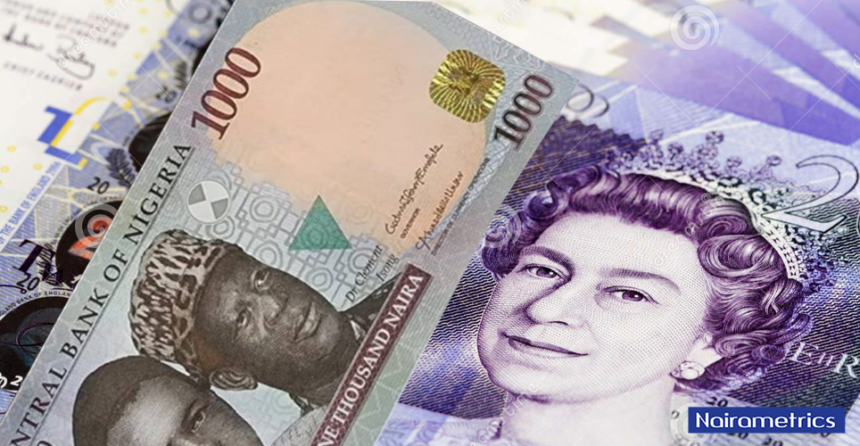
The Nigerian naira strengthened against the British pound on Nigeria’s foreign exchange market amid elevated political uncertainty in the British economy.
The naira settled at about N1,825/£1 as shown in Nigerian foreign exchange market.
In the medium term, the naira has been in form, strengthening against the pound by roughly 7 per cent this year, starting at N1,949/£1.
In addition, the British pound traded at about N 1,880/£1 per dollar to buy and N1905/£1 to sell in the black market, indicating strong forex demand from travelers and importers in the economy.
Foreign currency traders, however, indicate that the naira traded between N1, 350/$-1, 370/$ against the U.S dollar in deals with the official window (NFEM), as school fees abroad, medical services overseas, and overseas business transactions are in high demand.
The CBN has continued with a strong wave of intervention and tight monetary policy, with the apex MPR firmly at 26. 5 percent.
The Nigerian Central Bank’s successful liquidation of FX backlog debts brought in international portfolio investors to Nigerian debt instruments, ensuring a steady FX supply.
Increased crude oil production and a solid rise in energy prices during the first half of the year have bolstered Nigeria’s gross foreign reserves, while solid remittance flows from Nigerians abroad have continued to provide ample hard currency supply.
An increase in local refining capacity – notably the Dangote Refinery, which operates near its full 650, 650,000 bpd output – has made Nigeria far less dependent on imported refined oil. The refinery has been Nigeria’s largest source of dollars after crude oil.
Higher prices benefit export receipts and reserves, but risks push cost inflation due to elevated international transport and energy costs. Nigeria’s credit rating was revised to “B” with a stable outlook by S & P Global, as economic reform and currency unification have helped stabilize the macroeconomy and attracted renewed interest from foreign portfolio investors.
British Pound sterling weakened lower against the Greenback
The British pound sterling saw some follow-through selling for the third day in a row, weakening further below the $1.32 mark and hitting a new low since April at Friday’s trade session. The fundamental backdrop indicates that the path of least resistance is downward, and spot prices are still on track to record significant weekly losses.
- A bullish US dollar and the British pound’s continued relative underperformance amid persistent domestic political risks support the short-term negative outlook for the GBP/USD pair.
- Andy Burnham, the mayor of Greater Manchester, won a parliamentary seat in northern England on Friday, paving the way for an attempt to remove British Prime Minister Keir Starmer.
- Burnham told his party in his victory speech that this was the last opportunity to make a change and that the outcome might be a “turning point” for British politics.
Forex traders lowered their expectations for the Bank of England to raise interest rates more aggressively following the release of softer inflation data earlier this week.
- The US-Iran peace agreement also allayed worries about the energy shock, supporting the idea that the BoE will maintain stable interest rates. This is thought to be yet another element weakening the Sterling.
However, in the face of the US Federal Reserve’s (Fed) increasingly hawkish stance, the greenback is holding steady close to its highest level since late March, indicating the potential for at least one rate increase by year’s end.
Geopolitically speaking, US Vice President JD Vance cancelled his scheduled trip to Switzerland for negotiations with Iran, citing the lack of finalization.
Furthermore, Israeli airstrikes in Lebanon pose a threat to the US-Iran agreement. This strengthens the case for an extension of the GB.P/USD pair’s sharp decline from the weekly swing high, close to the $1.346 price action, and helps the safe-haven currency.