


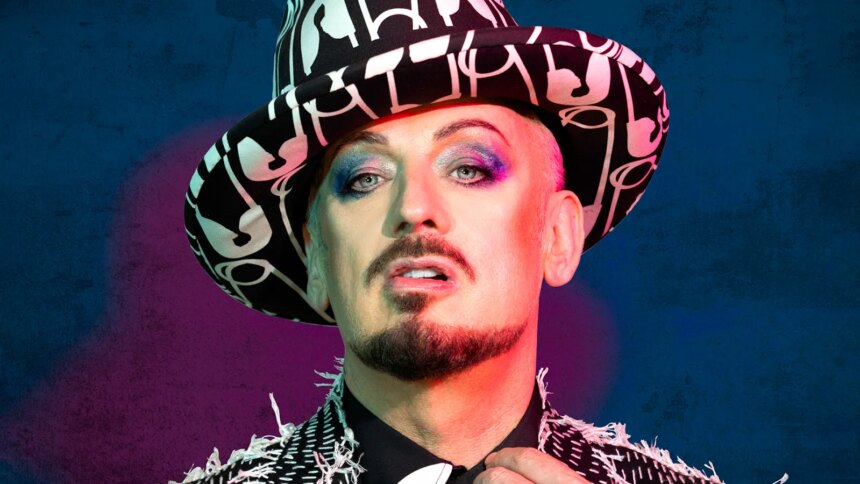
More than 40 years after its original release, Boy George and Culture Club have rerecorded their chart-topping hit, “Karma Chameleon,” using AI to recreate the vocal characteristics of the original 1983 recording. Alongside digital formats, the release will be available on vinyl in red, gold and green, the colors referenced in the song, featuring reimagined cover art. The rerecord marks the launch of Artist Included, a music technology company co-founded by Boy George’s manager, Paul Kemsley, and entertainment attorney and film producer Jeremy Rosen. Boy George serves as creative director.
Asked why he decided to recreate the song, Boy George has a simple answer: “Control!,” he tells Rolling Stone. “Having some say over where it goes. ‘Karma Chameleon’ is a secret weapon. It’s a song you starve the audience for because they want to hear it, and live, it’s always been a real pleasure to sing it. But in terms of what it does commercially, it’s like having something really powerful with your name on it, and you have no say about where it goes.”
The idea for the rerecord was prompted by a commercial sync license for “Karma Chameleon” involving Richard Branson for Virgin Voyages. Culture Club signed to Branson’s Virgin Records in 1982, and Boy George has maintained a close relationship with the entrepreneur ever since. According to Kemsley, Branson paid approximately $4 million for the deal ($2 million of which went to the master recording rights holders), while Boy George received only an appearance fee because he has never owned the masters for his biggest song.
“Karma’s a bitch,” Boy George states. “When we wrote that song, we weren’t looking 40 years ahead. We weren’t thinking of longevity. That song, because of the context of when it was recorded, the social feeling has stayed with people. It’s become part of people’s lives. Having control over it again, to a certain extent, is very exciting.”
The rerecord has a warmer vocal tone and sits slightly lower in the mix than the original, but is faithful enough to it that it plays like a remaster. The rerecording was produced by JJ Blair and Culture Club’s guitarist Roy Hay with additional production by song’s original producer, Steve Levine. Prior to the session, the AI was trained using archival demos licensed from Levine who had preserved them for decades. The instrumentation was newly recorded by Hay, Culture Club bassist Mikey Craig and session musicians. Only the vocal performance is AI-assisted.
“When I went into the studio to record it, I was like a pub singer imitating myself,” says Boy George. “You listen to where you pace things [sings the first line of ‘Karma Chameleon’]. You listen to where you put the voice: in your nose or your throat or chest. What you do instinctively as a 22-year-old, you don’t do as a 40-year-old or a 65-year-old. There’s a clipped way of singing it, which you forget through playing it live so many times. It was very European-sounding and youthful. I’ve taken it somewhere much more blues-y over the years, dragging out the notes. It’s about the nuance. When you sing something live over 40 years, it changes shape. It’s interesting to take it back to the original recording and recapture that feeling.”
Getting close to the original vocal is a hurdle for most musicians whose voices change over time. It took 18 months for Artist Included’s AI to work out the kinks. In the first iteration, Boy George sounded like “Pinky and Perky, two pigs on helium in a cartoon,” says Kemsley, referring to a children’s television series where the titular characters sing in high-pitched, fast-paced voices. The technology is now refined, and the plan is to rerecord Culture Club’s and Boy George’s entire back catalogs. Kemsley claims this will take two weeks, or as long as it takes Boy George to sing every song.
“I was a naysayer,” admits Boy George. “I was like, ‘This will never work.’ But I actually prefer this version [of ‘Karma Chameleon’]. For me, as the person that sang it originally, and re-sang it, what I love about this version, it has the sound of that time, but the warmth and experience and integrity of everything I’ve learned in my life.”
Kemsley, who has managed Boy George since 2014, frames the project as an attempt to rebalance longstanding industry economics. “This record has been making millions of dollars for [almost] 45 years, and George hasn’t,” says Kemsley. “The whole thing seems terribly unjust. You sign your life away at the age of 22, then have to wait 35 years to get the reversions, but you still don’t get any master recording income. Over the years, bands try to get their masters back and they never get them, with the major labels claiming they are work-for-hire.”
To put this in context, a record company often owns or controls master recording rights, a term stipulated when it signs an artist. That covers the music; the lyrics and composition are an entirely separate right known as publishing, which, by contrast, follows the composition, and therefore the song through every new recording. As a result, rerecords create a new master recording, and can benefit publishing by re-engaging the artist and generating renewed interest in the underlying work.
When it comes to rerecords, many artists are restricted to a certain length of time during which they are forbidden from releasing a new, faithful version to the original. Longstanding artists sometimes use Section 203 of the U.S. Copyright Act to reclaim rights to their masters after 35 years. They are rarely successful, as record companies often argue the masters were created as work made for hire.
The way Artist Included is structured, the artist receives the lion’s share of revenue. “The industry I was in no longer exists,” Boy George points out. “Artists like me are expected to carry on following that model. I haven’t done that for years. I used to say I’m the only person who realizes the ‘80s are over. You want to keep the spirit of that moment to some extent, but you move on. AI is not going anywhere, so having that conversation is exciting. And being ahead of the game in terms of how people use it, is also quite exciting for me.”
Considering Culture Club’s acrimonious split with their former drummer, Jon Moss, which resulted in a hefty settlement, rerecords of their songs also have the benefit of bypassing the need for his approval to use the original master recordings, which have four-way songwriting credit between its members.
“He still gets something from it,” clarifies Boy George. “Jon is a part of what we did [originally as a band].” But Kemsley is quick to point out that Moss is not a part of what they’re doing now with the rerecords, and is not entitled to any percentage of it. The band will see an increase in publishing, and as a credited songwriter, Moss will continue to receive publishing income, while the new master revenues do not involve him.
The next song queued up for rerecord is another signature Culture Club hit, “Do You Really Want to Hurt Me,” and Artist Included’s AI is primed, having retained Boy George’s voice for training purposes. The company has also been in conversations with publishing companies and other artists, mainly from the Eighties and Nineties, though no names are being disclosed yet. Kemsley says the conversations have not been a hard sell.
“People will react to what they see and hear,” says Boy George. “It’s much more powerful when people see it released and see what can happen.”
Kemsley notes Boy George turns 65 the day before the release of the new “Karma Chameleon,” which is the retirement age in the UK. “We’re not retiring,” Kemsley clarifies. “Far from it. We’re going back to the beginning, and we’re going to do it all again. We’re going to change the way revenue flows through to the artist. And we’re going to have some real fun with it.”