

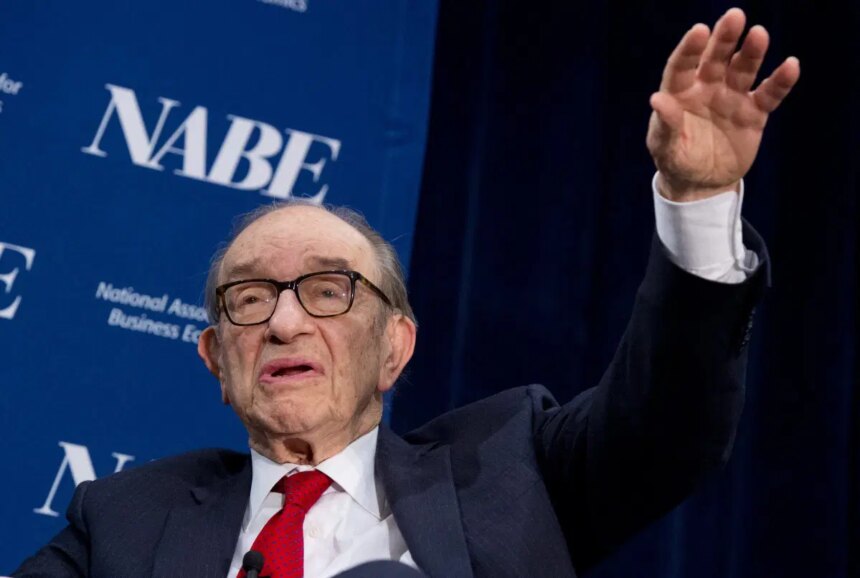
(FILES) Alan Greenspan, Former Chairman of the Federal Reserve Board, speaks on the current and future state of the US economy at the Economic Policy Conference hosted by the National Association for Business Economics in Arlington, Virginia, on February 24, 2014. AFP PHOTO / Saul LOEB. Greenspan, the longtime US Federal Reserve chief who presided over an unprecedented American economic expansion but was later faulted for failing to rein in financial markets before the 2008 global crisis, died on June 22, 2026, US media reported. (Photo by Saul LOEB / AFP)
Alan Greenspan, the US Federal Reserve chief who served four presidents and was hailed as the architect of the modern American economy, died Monday at age 100.
The influential economist spent more than 18 years heading the US central bank, overseeing unprecedented economic growth, but he was later criticized for fostering conditions that led to the 2008 global crisis.
“Under his leadership, the Federal Reserve achieved a sustained era of price stability that supported economic growth and helped anchor the public’s confidence in the institution,” the central bank said in a statement.
Greenspan’s wife Andrea Mitchell, a veteran correspondent with NBC News, said in a statement that he passed away from complications of Parkinson’s disease.
“He was a giant of a man who helped shape the U.S. economy for decades under presidents of both parties, but was always honest in acknowledging his mistakes,” she added.
The Fed on Monday expressed “deep sadness” at Greenspan’s passing, lauding his contributions to “monetary policy and economic thought,” according to a statement.
Greenspan served as the 13th chairman of the Fed Board of Governors and “left a last mark on this institution, on the broader field of economics, and on the country,” it said.
Mitchell, who married Greenspan in 1997, also highlighted what became her husband’s most quoted expression, “irrational exuberance,” a phrase Greenspan coined in 1996 to describe investor enthusiasm and economic optimism that can drive asset prices above their value.
The term became a catchphrase warning of an overheated stock market during a period of runaway American growth, when emotion and fear of missing out often trumped hard corporate data.
“He had ‘irrational exuberance’ for baseball, the Washington Commanders, tennis, golf and music, especially jazz,” Mitchell said.
A native New Yorker who excelled at math as a child but initially studied music before pivoting to economics, Greenspan spent decades in the inner circles of power in Washington.
Ronald Reagan named Greenspan to serve as chair of the Federal Reserve in 1987, replacing anti-inflation crusader Paul Volcker.
It was a position he would hold until January 2006 serving under four presidents — Reagan, George H.W. Bush, his Democratic successor Bill Clinton and George W. Bush.