

Monday morning, somewhere on Lagos Island, a fintech analyst opens her laptop, clicks “Join Meeting,” and watches the Spinning Wheel of Death (more formally, the Spinning Wait Cursor) as her office building’s Spectranet connection labours under the bandwidth demands of a nine o’clock client call.
She is not having a bad-luck day; she is having a Monday. She switches to her MTN hotspot.
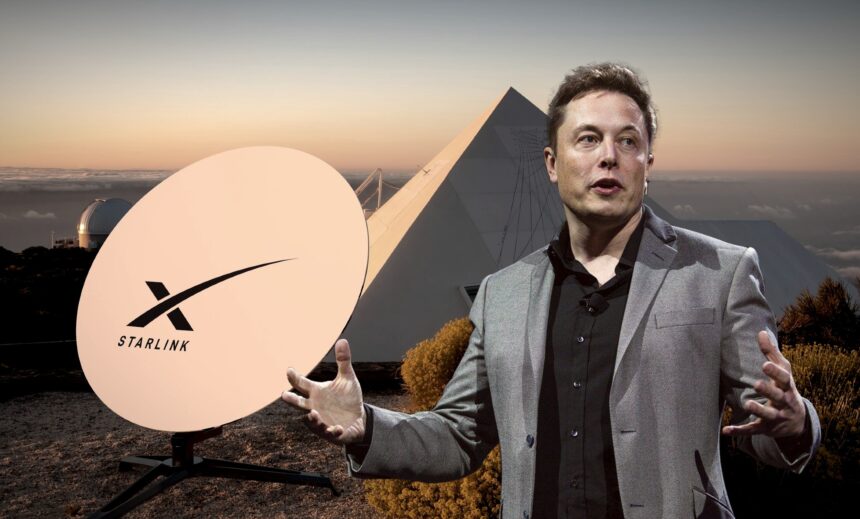
It too fails her because the nearest tower has been running on a generator overnight, and the generator ran out of diesel an hour ago. She reaches for the third option: a small white dish mounted on the rooftop, connecting her to a constellation of satellites orbiting 550Km overhead.
The green light blinks steadily, a quiet signal that Lagos is connected to the world. She pays N57,000 a month, roughly $38, after a one-time minimum payment of N590,000 for standard hardware kit. In contrast, businesses actually pay N159,000 per month.
On the same morning, Bloomberg’s Billionaires Index announces that Elon Musk has crossed $1 trillion in personal networth, officially becoming the world’s first trillionaire. She is paying rent to the world’s first trillionaire! Akin to spitting in the ocean to raise its water level. So are nearly 92,000 other Nigerians. This article is not a story about a genius. It is a story about what a nation chose not to build.
On June 12, 2026, SpaceX completed the largest initial public offering in history, raising $75 billion at a valuation of $1.77 trillion. Combined with his holdings in SpaceX and Tesla, with additional contributions from businesses such as X, xAI, Neuralink, and The Boring Company, Musk’s aggregate net worth reached approximately $1.1 trillion, according to Reuters. His wealth, though volatile, now exceeds the combined fortunes of the next four richest people on the planet.
The milestone is the product, not of one exceptional idea, but of a systematic strategy: substituting private productive capital for services that governments had monopolised or abandoned. Tesla commercialised the electric vehicle at scale. SpaceX made rocket reuse economically viable. Starlink deployed satellite broadband to markets that fibre and mobile networks had failed to reach.
Each company succeeded by building something governments had decided was too risky, too expensive, or too speculative to attempt. Starlink’s fastest-growing African market is a country whose government-owned satellite operator NigComSat earned $1.6 million in 2025. The irony is not accidental; it is structural.
Nigeria’s nominal GDP in 2025 is estimated at approximately US$334 billion, according to IMF projections. Musk’s personal net worth, $1.1 trillion, is roughly 3.3x that figure: the entire annual economic output of about 240 million people, the continent’s largest oil reserves, and the world’s largest English-speaking workforce, surpassed by one man’s accumulated capital.
Africa’s richest citizen, Aliko Dangote, was valued at $28.5 billion by Forbes in March 2026 with 2.6% of Musk’s wealth. Dangote’s industrial achievements are genuine: the world’s largest single-train petroleum refinery, a cement business spanning fifteen African countries, a fertiliser plant that has materially influenced continental urea prices. But the total wealth of every Nigerian billionaire on the Forbes list combined does not approach what one American entrepreneur accumulated by building technologies that did not previously exist. The gap is not personal ambition. It is the predictable output of very different institutional incentive structures.
Nigerian billionaires are, with few exceptions, rent-seekers: their wealth derives from privileged access to oil licences, government contracts, import waivers, and telecoms spectrum. This is a structural observation, not a moral one. Rent is the rational response to an environment in which political access (with little accountability) yields higher returns than innovation and Nigeria’s institutions have, for six decades, made political access the more reliable investment.
Musk’s wealth is of a different character: productive capital, generated by companies that created industries rather than capturing rents from existing ones. Thomas Piketty’s r > g, the tendency for the return on capital to exceed economic growth, explains why wealth concentrates over time. But the type of r is decisive: rent-seeking r transfers wealth from the public to the rentier while leaving total output broadly unchanged; productive r can expand the output base before concentrating gains. Nigeria has built almost its entire billionaire class on the first kind. The numbers show it.
Starlink’s Nigerian story is the article’s central case study. Following a regulatory standoff in which the NCC insisted on local content compliance before granting an operating licence, a demand Starlink eventually negotiated away, the service launched and grew at a rate that exposed the scale of Nigeria’s broadband failure more vividly than any government white paper. From 23,897 subscribers at end-2023, Starlink reached 91,991 by end-2025, nearly quadrupling its base in two years.
It is now Nigeria’s second-largest internet service provider by subscriber count. June 2026 market reports suggest that Spectranet, Starlink, and FibreOne together account for a dominant share of Nigeria’s fixed broadband ISP market, reflecting a highly concentrated sector.
Of the three leading ISPs, Starlink is foreign-owned, FibreOne is locally owned, and Spectranet, though it has had international partnerships, is primarily a Nigerian operator currently undergoing consolidation in the broadband market. The commanding heights of Nigeria’s digital economy are increasingly largely foreign. Not because Nigeria was crowded out but because Nigeria did not show up.
The NCC’s own data makes the failure statistical. Nigeria’s National Broadband Plan 2020-2025 committed to achieving 70% broadband penetration by the end of 2025, a target unveiled with ministerial press conferences, repeated regulatory assurances, and later reinforced by a $500 million World Bank-backed digital infrastructure programme.
That ambition looks well in a policy document. Actual penetration at year-end 2025 was 50.58%, a 19.4% gap confirmed by NCC’s own monthly subscriber data and widely reported by the media. That near-20-point gap now belongs to a satellite company headquartered in Texas.
The obstacles were not mysterious as the NCC reported in 2025 that fibre optic cables vandalised daily averaged about 157 across the country, cut for scrap metal at a rate no investment programme has contained. As at April 2026, only fifteen of Nigeria’s thirty-six states have removed the Right-of-Way fees that make fibre deployment economically unviable for private operators. Twenty-one have not.
The cost of this infrastructure dependency is quantifiable in precise terms. Nigeria’s telecoms sector generated ₦7.67 trillion (approximately $5.1 billion) in revenue in 2024, according to the NCC. MTN Nigeria and Airtel Africa together accounted for more than 85%, roughly $4.4 billion, flowing annually through companies answerable to foreign shareholders.
Starlink’s 92,000 Nigerian subscribers at ₦57,000 per month add approximately ₦62.9 billion ($41.9 million) in annual subscription revenue that is largely repatriated to the United States. Set against this is the performance of Nigeria’s own sovereign satellite. NigComSat Limited generated about $1.6 million in total revenue in 2025, while simultaneously carrying $11.4 million in unpaid fees to the China Great Wall Industry Corporation, the Chinese contractor responsible for technical support of its communications satellite.
NigComSat-1R, launched in 2011 with a fifteen-year design life, has been extended to 2028 through careful fuel management. Replacement satellites, NigComSat-2A and 2B, are planned for 2028 and 2029. Starlink earns more from Nigerian subscribers in just over two weeks than NigComSat earns in an entire year. That single comparison contains the entire structural argument.
The article proposes three specific reforms. First, the federal government should resolve NigComSat’s $11.4 million unpaid debt without further delay and capitalise the NigComSat-2A and 2B programme with an explicit commercial broadband mandate: not a government television mandate, not a broadcasting mandate, but a broadband mandate measured in subscriber counts and megabits per second relative to Starlink. A sovereign satellite earning $1.6 million annually while a foreign competitor earns more in weeks from Nigerian customers alone is not a budget problem. It is a design problem.
Second, the National Assembly should legislate a uniform Right-of-Way fee cap across all thirty-six states, ending the patchwork of twenty-one state-level tariff regimes that price national fibre infrastructure out of rational investment. The fifteen states that removed these fees demonstrated the outcome: measurable improvement in fibre deployment and penetration. Federal legislation should replicate this at scale without waiting for the remaining twenty-one states to act voluntarily.
Third, Nigeria must treat its engineers, software developers, and technology professionals as productive capital that compounds when retained. An estimated 16,000 Nigerian doctors, not to talk of engineers, left the country in the five years to 2024. Many of them are, today, employed at the companies invoicing Nigeria monthly. Equity participation in state-sponsored technology ventures, diaspora investment structures, and deliberate domestic employment pipelines for technology professionals are not aspirational ideas. They are the instruments through which this arithmetic changes.
This article is not an argument against foreign investment in Nigerian digital infrastructure. MTN and Airtel built the mobile networks that connected more Nigerians than the state ever managed to, and that contribution is real. Foreign capital has frequently been the only capital that appeared when domestic capital would not. The argument is more precise: filling a gap is not the same as owning the economy of the gap.
There is a version of Nigeria’s future in which the country permanently rents its digital infrastructure from abroad – American satellite operators, Chinese satellite builders – while NigComSat earns $1.6 million a year, each broadband plan target is missed by twenty points, and each generation of Nigerian engineers emigrates to build other countries’ infrastructure on Nigeria’s behalf. That version is available without any further effort. It is the default. The alternative, a sovereign satellite with a commercial mandate, nationally harmonised Right-of-Way fees, and a domestic technology talent base, requires deliberate choice against institutional inertia. It is harder. It is also the only version in which the scenario projections improve.
The author’s modelling suggests a credible reform path could bring Nigeria to about 80% broadband penetration by 2030, against a status quo trajectory that plateaus below 60%, a near 20-point difference that is not a technical metric but an economic one. At 80%, broadband is a productive input available to the majority of businesses and households but at below 60%, it remains a premium service that the well-resourced rent from foreign satellite operators earn.
One man’s net worth exceeding a nation’s GDP is striking on a front page, but the more important number is the one that describes what Monday morning looks like for 92,000+ Nigerians who have quietly decided that the most reliable solution to their country’s infrastructure gap is a monthly direct debit to a trillionaire’s satellite company. The green light above Lagos Island is not Musk’s achievement alone. It is also Nigeria’s choice and choices, unlike satellites, can be changed without waiting for a launch window.
- Akinola Morakinyo (Ph. D) writes on MINT economies from the Department of Economics, Finance & Quantitative Analysis, Kennesaw State University, GA, USA