

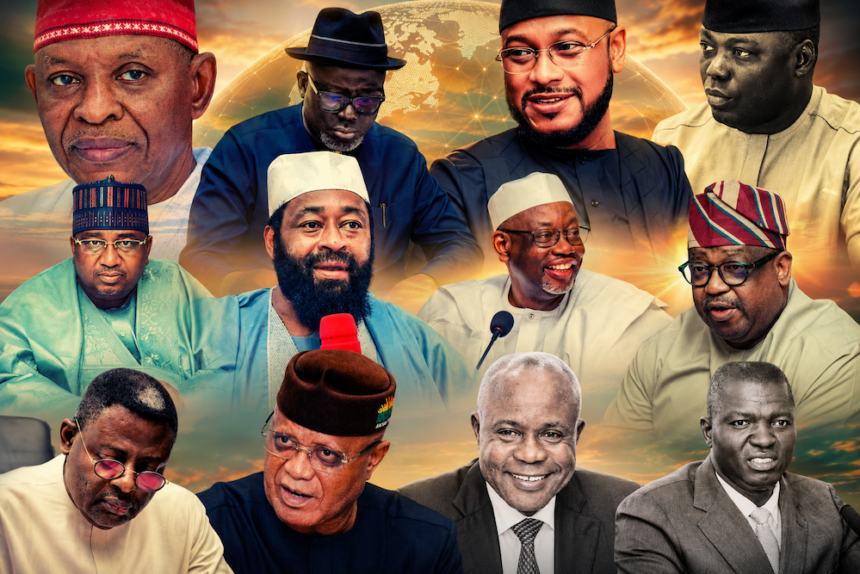

The nationwide governorship primary elections of the All Progressives Congress (APC) were characterised by a whirlwind of high-stakes political manoeuvres, reshaping the sub-national balance of power across Nigeria.
Rather than being defined by fierce electoral contests alone, the primaries were largely shaped by elite negotiations, consensus arrangements, strategic defections, regional balancing and the influence of powerful political actors operating behind the scenes.
In many states, the outcome appeared settled long before delegates cast their votes, reflecting the growing dominance of political calculations over open competition within the ruling party.
The primaries, conducted in line with the Independent National Electoral Commission (INEC) timetable, produced candidates in 28 states.
The exercise excluded Anambra, Bayelsa, Edo, Ekiti, Imo, Kogi, Ondo and Osun states, which currently operate on “off-cycle” schedules because past court rulings overturned flawed elections or altered the tenures of sitting governors.

Consequently, the party focused its logistical and strategic machinery exclusively on the remaining 28 states, where intense zoning debates, high-profile defections, and deep party horse-trading took centre stage. They include;
- North-west: Kano, Kaduna, Katsina, Kebbi, Sokoto, Jigawa, Zamfara
- North-east: Borno, Yobe, Gombe, Bauchi, Adamawa, Taraba
- North-central: Kwara, Niger, Nasarawa, Benue, Plateau
- South-west: Lagos, Ogun, Oyo
- South-south: Rivers, Akwa Ibom, Delta, Cross River
- South-east: Abia, Enugu, Ebonyi
A review of the primaries shows five dominant themes: the increasing use of defections as a political recruitment strategy, the overwhelming advantage enjoyed by incumbents, the growing preference for consensus and affirmation arrangements, the continuing relevance of zoning in succession politics and the enduring influence of party power brokers in determining outcomes.
Defections
One of the most striking features of the primaries was the extent to which the APC benefited from the defection of opposition governors and political heavyweights.
In several states, the most consequential political battles occurred before the primaries themselves, as the party focused on negotiating the entry of influential opposition figures and integrating their political structures into the APC. Once those negotiations were concluded, the primaries became largely procedural exercises.
Governors such as Abba Yusuf of Kano, Dauda Lawal (Zamfara), Sheriff Oborevwori (Delta), Agbu Kefas (Taraba), Caleb Mutfwang (Plateau), Umo Eno (Akwa Ibom) and Peter Mbah (Enugu) all emerged as major beneficiaries of this strategy after aligning with the ruling party.
Their emergence underscores the APC’s determination to expand its political footprint ahead of 2027, not merely through electoral competition but through strategic acquisitions of existing political structures controlled by incumbent governors.
Incumbency
The primaries also reinforced a long-established reality in Nigerian politics: incumbency remains one of the most powerful advantages available to any politician.
In state after state, sitting governors seeking second terms encountered little resistance from within their party.
Governors, including Uba Sani of Kaduna, Dikko Radda of Katsina, Nasir Idris of Kebbi, Umar Namadi of Jigawa, Hyacinth Alia of Benue, Francis Nwifuru of Ebonyi and Bassey Otu of Cross River, secured their tickets either unopposed or through affirmation exercises that effectively eliminated competitive challenges.
The pattern suggests that control of state party structures, access to government resources, influence over local political networks and endorsement by party stakeholders continue to provide incumbents with overwhelming advantages during candidate selection processes.
Consensus arrangements
Another defining characteristic of the APC primaries was the widespread use of consensus and affirmation mechanisms.
While the party leadership consistently defended such arrangements as necessary to preserve unity and prevent post-primary disputes, critics argue that they often reduced opportunities for genuine internal competition and weakened the democratic character of the selection process.
Governors who benefited from this system included Dikko Radda (Katsina), Uba Sani (Kaduna), Nasir Idris (Kebbi), Umar Namadi (Jigawa), Hyacinth Alia (Benue), Bassey Otu (Cross River), Francis Nwifuru (Ebonyi), Umo Eno (Akwa Ibom), Peter Mbah (Enugu), Sheriff Oborevwori (Delta), Caleb Mutfwang (Plateau), Agbu Kefas (Taraba), Dauda Lawal (Zamfara) and Abba Yusuf (Kano), all of whom either secured return tickets or emerged with overwhelming support.
The trend reflects a broader preference within the party for stability and predictability, particularly in states where leaders feared that open contests could deepen existing factional divisions.
Zoning
In states where governors are approaching the end of their constitutionally permitted two terms, zoning and regional balancing emerged as major considerations.
In Kwara, House of Assembly Speaker Salihu Danladi benefited from longstanding demands that power shift to Kwara North. In Ogun, Olamilekan Adeola (Yayi), a serving senator, emerged amid arguments that Ogun West should produce the next governor, for the first time in the state’s history.
In Yobe, Baba Wali’s emergence reflected efforts to maintain regional balance, while in Nasarawa, Ahmed Wadada’s victory followed intense debates over succession and senatorial zoning considerations.
Although zoning arrangements remain unofficial in many instances, they continue to serve as important tools for managing competing regional interests and preserving political stability within party structures.
Power brokers
Despite repeated calls for greater internal democracy, the primaries demonstrated the continued influence of political godfathers and power brokers.
Former governors, serving ministers and senior party leaders played decisive roles in shaping outcomes across several states.
In Sokoto, the influence of Aliyu Wamakko, a former governor and serving senator, remained critical to Governor Ahmad Aliyu’s emergence. In Katsina, former Governor Aminu Masari’s support strengthened Governor Dikko Radda’s position. In Ebonyi, the political structure built by Minister of Works David Umahi, a former governor, continued to shape the state’s APC politics.
Similarly, Vice President Kashim Shettima and Governor Babagana Zulum were widely regarded as influential figures in the emergence of Mustapha Gubio in Borno, while Governor AbdulRahman AbdulRazaq played a key role in the succession calculations that produced Mr Danladi in Kwara.
The recurring influence of these figures highlights the extent to which personal political networks remain deeply embedded in Nigeria’s party system.
Controversies
Although the APC largely avoided the large-scale crises that have accompanied some previous primary elections, several contests exposed unresolved tensions within the party.
Rivers State generated significant controversy following the withdrawal of Governor Siminalayi Fubara from the race and the subsequent emergence of Kingsley Chinda as the party’s candidate. Ogun witnessed legal threats after rival aspirant Abayomi Hunye challenged the outcome of the primary election.
In Abia, disagreements over an alleged consensus arrangement led to open disputes among party stakeholders, while Benue’s primary reflected the continuing rivalry between Governor Hyacinth Alia and Secretary to the Government of the Federation George Akume.
These disputes suggest that while the party succeeded in producing candidates across all participating states, the challenge of managing post-primary grievances remains far from over.
State-by-state breakdown
Kano State: Abba Yusuf
Governor Yusuf secured the APC gubernatorial ticket for his second-term bid after his high-profile defection from the NNPP earlier in the year.
Mr Yusuf was the crown jewel of the Kwankwasiyya movement, a highly disciplined political group led by former Governor Rabiu Kwankwaso. However, facing immense political pressure and fearing that ongoing legal battles would strip him of his seat, Mr Yusuf chose to switch political parties.

Mr Yusuf did not move alone; he moved alongside more than 20 members of the State House of Assembly, more than 40 local government chairpersons, and several lawmakers in the National Assembly.
The primary itself was a swift coronation, with the national leadership affirming him as the sole candidate.
Zamfara State: Dauda Lawal
Governor Lawal emerged as the APC flagbearer following his defection from the PDP.

His emergence was facilitated by a broad coalition of APC stakeholders, including four former governors who had been bitter enemies for years – Ahmed Yarima, Mahmuda Shinkafi, Abdul’aziz Yari, and Bello Matawalle.
They put aside their historical animosities and all gathered at the Gusau Trade Fair ground to endorse Mr Lawal, positioning the state as a unified APC front.
Delta State: Sheriff Oborevwori
For over two decades, Delta State was considered an unshakeable stronghold for the opposition PDP.
That reality was shattered when Mr Oborevwori made the calculated decision to defect to the ruling APC, eventually securing the party’s governorship ticket. Mr Oborevwori won the nomination through a direct primary election, a mechanism where every single card-carrying party member cast a vote at the ward level, earning him 345,375 votes across 270 wards.
![Governor Sheriff Oborevwori of Delta State [PHOTO CREDIT: Rt Hon Sheriff Oborevwori ]](https://i0.wp.com/media.premiumtimesng.com/wp-content/files/2025/01/469277089_10160191728532191_2241243012532812935_n.jpg?resize=2048%2C1366&ssl=1)
The entire move was engineered by powerful federal officials, including the Minister of Aviation, Festus Keyamo, who moved the formal motions to absorb the governor’s extensive political structure.
Ogun State: Solomon Adeola (Yayi)
Ogun West Senator Solomon Adeola, widely known as “Yayi,” emerged as the candidate to succeed the outgoing governor, Dapo Abiodun, who is rounding off his second term.
Although most of the power brokers in Ogun, including all the past governors since 1999, supported Mr Adeola, a challenger emerged.
The rival aspirant, Mr Hunye, officially scored zero votes across the state’s 236 wards, an allocation he fiercely rejected. He convened a press conference in Abeokuta, alleging that his supporters were harassed, beaten, and systematically blocked from voting centres, while the final results were pre-written in hotels.
Mr Hunye has since filed a lawsuit in the Federal High Court in Abuja, demanding the absolute nullification of the primary.
Borno State: Mustapha Gubio
With Governor Zulum reaching his constitutional two-term limit, the Borno State APC chapter executed its succession plan.
Mustapha Gubio emerged unopposed as the new governorship candidate during a peaceful primary in Maiduguri. The entire selection process was managed under the strict guidance of Vice President Shettima and Mr Zulum, who worked together to clear the field early.
Adamawa State: Ahmed Galadima
Unlike its neighbours, Adamawa State rejected the idea of a quiet consensus and instead hosted a highly competitive, vocal direct primary election. Ahmed Galadima, the former Executive Secretary of the Petroleum Technology Development Fund (PTDF), won a decisive victory by polling 414,444 votes.
Mr Galadima outmanoeuvred several deeply entrenched local politicians by building a coalition that crossed regional and ethnic lines within the state.
He defeated prominent contenders, including Abdulrazaq Namdas, who finished second, and Abdullahi Haske, who finished third.
Ahead of the primary election, three other aspirants – Diaulhaq Abubakar, Mustapha Salihu, and Alhaji Thul stepped down to support his candidacy.
Announcing his decision, Mr Abubakar said the move was necessary to strengthen party unity and advance collective progress, calling on his supporters across the state to back Mr Galadima.
He also pledged N200 million, alongside his campaign structures across the state, in support of the Galadima campaign.
Mr Salihu stepped down from the governorship race in the interest of party cohesion and later declared his intention to contest the Adamawa Central senatorial seat.
Mr Thul also withdrew his governorship ambition, describing the decision as an act of sportsmanship, and threw his support behind Mr Galadima’s candidacy.
Taraba State: Agbu Kefas
Taraba State added another major piece to the APC’s collection of state governments.
Governor Kefas defected from the PDP this year and subsequently won the APC primary with 166,357 votes.
He defeated former Minister of Works Sambo Jaji, who got 4,110, to clinch the APC ticket, following the withdrawal of frontline aspirant David Kente.
![Governor of Taraba State, Agbu Kefas [PHOTO CREDIT: Agbu Kefas on Facebook]](https://i0.wp.com/media.premiumtimesng.com/wp-content/files/2024/09/460051791_1010402451096085_151267041139685345_n.jpg?resize=1440%2C960&ssl=1)
Before the primary, he was heavily endorsed by APC state stakeholders in May, though this initially faced some resistance from other aspirants.
However, Mr Kente criticised the consensus arrangement and rejected the process.
During the endorsement, serving senators, members of the House of Representatives, members of the State House of Assembly, and former deputy governors were present.
Kwara State: Salihu Danladi
The primary in Kwara State was defined by major scheduling delays and a very competitive three-way race over who would inherit the legacy of the historic Otogee movement, the popular uprising that swept the old political dynasty out of power four years ago.
Mr Danladi, the current speaker of the Kwara State House of Assembly, only emerged as the outgoing governor’s choice candidate on the day of the primary after the governor dropped his earlier choice for the ticket.
Mr Danladi eventually won the rescheduled race, defeating his main challengers, Abdulfatai Seriki and the former state party chairman, Bashir Bolarinwa.
The primary was a battle over the legacy of the “Otogee” (Enough is Enough) movement and the succession path chosen by Governor AbdulRazaq, with various regional blocs fighting over zoning promises for the Kwara Central and North senatorial districts.
Mr Danladi’s win was a strategic response orchestrated by Mr AbdulRazaq to address longstanding agitations from Kwara North.
Since the return to democracy in 1999, Kwara Central has dominated the governorship space for much of the Fourth Republic, cumulatively ruling for 20 years. In many communities in Baruten, Kaiama, Moro, Edu, and Patigi, there is a growing sentiment that 2027 should naturally favour Kwara North as a matter of fairness and political balance.
That sentiment partly explains why Mr Danladi’s emergence immediately generated excitement across many parts of the northern axis.
Kaduna State: Uba Sani
The Kaduna State chapter prioritised administrative continuity by clearing the path for the incumbent governor, Uba Sani, to secure his return ticket unopposed.

The state’s primary committee organised a centralised affirmation exercise in the state capital, neutralising potential regional and religious friction before it could spill into the public domain.
Mr Sani’s ability to balance the interests of the diverse southern Kaduna groups with those of the powerful political blocs in the northern senatorial district enabled the party leadership to bypass a volatile, competitive primary, ensuring a unified front ahead of the general election.
Rivers State: Kingsley Chinda
Rivers State provided the most complex narrative of the primary week.
Kingsley Chinda emerged as the governorship candidate of the All Progressives Congress (APC), scoring 268,497 votes.
However, beneath the celebration lay a staggering political paradox that raised eyebrows. Mr Chinda was a high-ranking member of the opposition Peoples Democratic Party (PDP), serving as the minority leader in the House of Representatives. His sudden transformation into the APC flagbearer sparked fierce debate over party switching, dual membership, and the legality of a federal lawmaker leading an opposition bloc in Abuja while securing the ruling party’s highest ticket back home.
This historic shift was only made possible by the sudden, last-minute withdrawal of the incumbent governor, Siminalayi Fubara. Leading up to the primary week, Mr Fubara had been a central figure trying to anchor himself within the state’s APC structure.

Yet, behind the scenes, a fierce structural war was raging for absolute control of the state party machinery between Mr Fubara’s administration and loyalists of his predecessor, the Minister of the Federal Capital Territory, Nyesom Wike. When the APC screening committee met to clear candidates for the primary, almost all of Mr Fubara’s core loyalists, defenders, and legislative allies were systematically screened out and denied the chance to contest.
Realising that the internal party platform had been completely rigged against his team, Mr Fubara made a shocking announcement just hours before the delegate voting was scheduled to begin.
He officially pulled out of the race. He explained that his decision came after deep, exhausting consultations with his family and closest political associates, stating calmly that true leadership requires personal sacrifice to maintain peace and prevent physical violence in the state.
Katsina State: Dikko Radda
Determined to avoid a repeat of the factional disputes and prolonged disagreements that characterised previous governorship primaries, key stakeholders of the APC in Katsina adopted an early consensus arrangement in favour of the state governor, Dikko Radda. The strategy was designed to preserve party unity and prevent the emergence of rival camps that could weaken the party ahead of the general election.

Mr Radda’s position was further strengthened by the support of former governor Aminu Masari, whose political influence remains significant across the state’s three senatorial districts.
With the backing of major party leaders, elected officials and grassroots structures, no aspirant formally challenged the governor for the party’s ticket, effectively making the primary a ratification exercise.
Kebbi State: Nasir Idris
The state governor, Nasir Idris, a man popularly known across the northwestern state as “Kauran Gwandu,” enjoyed a completely unbothered path to his second-term nomination.

His deep professional background as a longtime labour union leader and his close alliance with the state’s massive civil service workforce completely protected him from internal challenges.
The Kebbi primary was essentially a giant celebration, with thousands of delegates from all local government areas gathering to unanimously support his candidacy without a single complaint or rival petition.
Sokoto State: Ahmad Aliyu
The primary election in Sokoto State provided a clear example of godfather-driven political stability.

The state governor, Ahmad Aliyu, won his nomination through a highly structured consensus system under the direction of the state’s APC leader, Aliyu Wamakko, a Sokoto North senator and former governor of the state.
By taking control of the local party structures months in advance, Mr Wamakko’s inner circle easily discouraged any ambitious rivals from coming forward, ensuring that Mr Aliyu’s affirmation went ahead smoothly and without any public arguments.
Jigawa State: Umar Namadi
Jigawa State followed a plan of careful continuity, giving Governor Umar Namadi an uncontested return ticket to run for his second term.
Mr Namadi officially emerged as the sole consensus candidate for the 2027 gubernatorial election. Following endorsements from all 287 political wards, the party leadership skipped competitive primary voting in favour of a voice vote and affirmation at the Dutse Stadium, securing his return ticket to seek a second term.

The political network created by his predecessor, the current Minister of Defence, Mohammed Abubakar, remained fully operational and unified.
The party leadership in Dutse chose to completely skip a competitive vote to protect their existing legislative alliances, giving Mr Namadi a clear mandate to lead the party into the next campaign season.
Yobe State: Baba Wali
With Governor Mai Buni set to complete his constitutionally permitted two terms in 2027, succession politics dominated the APC’s calculations in Yobe. The contest was shaped by intense consultations among party leaders and influential stakeholders over the state’s longstanding power-sharing considerations, particularly between the Yobe North and Yobe East senatorial zones.

After weeks of negotiations aimed at preventing divisions within the ruling party, the APC leadership coalesced around Baba Wali, the immediate past Secretary to the State Government, as its preferred candidate. The arrangement was widely seen as an effort to preserve internal cohesion and maintain the delicate regional balance that has historically influenced leadership transitions in the state.
The strategy paid off at the primary election, where Mr Wali secured a landslide victory, polling 236,711 votes to defeat his closest challenger, Abubakar Kagu, who garnered 9,748 votes.
Gombe State: Jamilu Gwamna
With Governor Muhammadu Yahaya approaching the end of his second and final term, the battle to succeed him emerged as one of the most closely watched contests in the North-east.
The race attracted several prominent figures within the APC, including former ministers and senior party stakeholders.
To avoid internal fractures and ensure continuity of the administration’s political agenda, party leaders and key stakeholders engaged in extensive consultations that culminated in broad support for Jamilu Gwamna.
The arrangement ultimately strengthened Mr Gwamna’s position at the direct primary election, where he secured a commanding 247,161 votes.
He defeated Isa Ali Pantami, who polled 12,120 votes, and Saidu Alkali, who garnered 11,612 votes.
Bauchi State: Mohammed Abubakar
The APC governorship primary in Bauchi produced one of the most dramatic outcomes of the party’s nationwide selection process, culminating in a major political comeback for a former governor, Mohammed Abubakar.
With the incumbent governor, Bala Mohammed, set to complete his second and final term in 2027, the race attracted some of the state’s most influential political figures, including former Minister of Foreign Affairs Yusuf Tuggar and former Nigerian National Petroleum Company executive Bala Wunti.
The process was reportedly characterised by high-level bargaining among various blocs seeking to influence the party’s direction ahead of the general election. After hours of delays and consultations, Mr Abubakar emerged victorious with 57,517 votes, comfortably ahead of Mr Tuggar, who secured 26,001 votes.
The result marked a remarkable political resurgence for Mr Abubakar, who lost his re-election bid to Mr Mohammed in 2019, becoming the first incumbent governor in Bauchi’s history to fail in a second-term attempt. His victory also underscored the enduring strength of his political network across the state, despite years outside office.
Particularly notable was the defeat of Mr Tuggar, who had resigned from President Bola Tinubu’s cabinet in compliance with the APC’s requirement that political appointees seeking elective offices step down before pursuing their ambitions.
Although his candidacy generated considerable attention and enjoyed support from sections of the party, it ultimately failed to overcome the former governor’s entrenched grassroots structure and long-established political machinery.
The APC is now expected to rely heavily on Mr Abubakar’s statewide reach and name recognition as it seeks to reclaim Bauchi from the PDP in 2027.
Niger State

Governor Umaru Bago won his second-term ticket unopposed during an organised consensus primary held in Minna.
Mr Bago’s massive agricultural investments and his strong relationships with the state’s powerful traditional rulers left no room for any realistic internal challenges.
The state party leadership praised the event’s absolute lack of drama, using it to showcase Niger State as a prime example of internal party unity.
Benue State: Hyacinth Alia

Benue witnessed one of the APC’s most contentious and politically significant primary contests, serving as a referendum on the influence of its governor, Hyacinth Alia, within a party deeply divided by an extended power struggle.
Despite facing strong opposition from influential party stakeholders and elements of the state APC structure, Mr Alia secured the party’s governorship ticket, consolidating his grip on the party ahead of the 2027 election.
The primary unfolded against the backdrop of a prolonged rivalry between the governor and George Akume, Secretary to the Government of the Federation (SGF). The dispute split the party into competing factions, each claiming legitimacy and control of the party machinery.
Concerned by the growing divisions, the APC national leadership and President Bola Tinubu reportedly encouraged reconciliation efforts, leading to a high-level peace meeting convened by Mr Akume in Makurdi.
Although Mr Akume emerged from the meeting advocating automatic return tickets for elected APC officeholders, Mr Alia rejected that interpretation, insisting that neither the president nor the party leadership had endorsed such an arrangement. The disagreement exposed the deep mistrust between both camps and effectively turned the primaries into a test of political supremacy.
The outcome strongly favoured the governor. In the National Assembly primaries conducted shortly before the governorship exercise, several federal lawmakers widely regarded as allies of Mr Akume lost their return tickets, while many candidates believed to be aligned with the governor emerged victorious. Political observers interpreted the results as evidence of Mr Alia’s growing influence within the party structure and a significant weakening of the SGF’s hold on the APC in the state.
While some prominent figures linked to Mr Akume retained their positions, including his wife, Regina Akume, the broader outcome reinforced the governor’s dominance.
His emergence as the APC governorship candidate, therefore, represented more than a routine primary victory; it marked a decisive moment in the internal battle for control of the party in Benue and positioned him as the central figure in the state’s APC ahead of the 2027 governorship election.
Nasarawa State: Ahmed Wadada
The APC governorship primary in Nasarawa was preceded by weeks of intense political manoeuvring as party leaders grappled with competing interests over zoning, consensus arrangements and the mode of selecting a successor to Governor Abdullahi Sule, who is set to complete his second term in 2027.
While some stakeholders pushed for a consensus candidate to avoid internal divisions, the plan collapsed after multiple aspirants insisted on testing their popularity at the ballot box.
The debate reflected broader succession calculations within the ruling party, particularly after Mr Sule openly endorsed Nasarawa West Senator Ahmed Wadada as his preferred successor.

The endorsement immediately positioned Mr Wadada as the frontrunner but also triggered resistance from rival aspirants who argued that the party should allow a competitive process rather than impose a candidate.
Among the most vocal was Muhammed Liman, who publicly rejected calls to step down and insisted that no aspirant should be pressured to withdraw in favour of another contender.
His stance contributed to the party’s decision to abandon consensus and conduct a direct primary across the state’s 147 electoral wards.
When the votes were counted, Mr Wadada emerged victorious, defeating six other aspirants to secure the APC governorship ticket.
Plateau State: Caleb Mutfwang
The APC governorship primary in Plateau was largely shaped by Governor Caleb Mutfwang’s dramatic political realignment from the PDP to the ruling party, a move that significantly altered the state’s political landscape ahead of the 2027 election.
Mr Mutfwang formally resigned from the PDP on 29 December 2025, citing the need for “purposeful leadership, clarity of direction and effective service delivery,” before officially joining the APC on 2 January 2026 after weeks of consultations with party leaders and stakeholders.

Several influential APC leaders, including former officeholders and National Assembly members, publicly welcomed the governor into the party, reflecting a broad accommodation of interests aimed at preserving unity ahead of the primaries.
By the time the governorship primary was conducted, Mr Mutfwang had effectively secured the backing of the dominant forces within the party. He went on to record a sweeping victory, polling 233,335 votes against the 3,070 votes secured by his only challenger, a retired Navy Commodore, Yilchini Bida.
The governor won across all 17 local government areas, underscoring both the strength of his political machinery and the broad coalition that had formed around his candidacy following his defection.
Oyo State: Sharafadeen Alli
Oyo State witnessed an incredibly competitive open primary that tested the strength of the state’s different political factions.
The race featured intense consultations among party leaders, regional blocs, and influential stakeholders as aspirants jostled for support in a contest widely seen as a battle for the party’s future direction in the state.
Sharafadeen Alli, who represents Oyo South in the Senate, eventually emerged as the party’s governorship candidate after defeating strong contenders, including Oyo North senator Fatai Buhari and former Minister of Power, Adebayo Adelabu.
Mr Alli’s victory was controversial, with the APC failing to announce official results for several days amidst allegations of massive rigging.
Controversy also emerged over reports claiming that Mr Alli polled 578,143 votes, while Mr Buhari and Mr Adelabu secured 37,265 and 19,193 votes, respectively.
Party stakeholders and observers questioned the figures, noting that the APC’s registered membership in Oyo is reportedly well below 200,000, making the published vote totals difficult to reconcile with the party’s known voter base.
The dispute over the figures briefly overshadowed the outcome, although it did not alter Mr Alli’s emergence as the APC’s standard-bearer for the 2027 governorship election.
Lagos State: Obafemi Hamzat
The APC governorship primary in Lagos was largely shaped by an early consolidation of support around Deputy Governor Obafemi Hamzat, making him the first deputy governor in the state’s history to secure his party’s governorship ticket.
Although the contest initially attracted several aspirants, extensive consultations among party leaders and stakeholders significantly narrowed the field before voting day.

At least four aspirants purchased nomination forms, but two – Abdul-Azeez Adediran, popularly known as Jandor, and Samuel Ajose – withdrew from the race before the primary, leaving Mr Hamzat and Olanrewaju Jim-Kamal as the only contestants.
The outcome reflected that consensus. Conducted across the state’s 245 wards in 20 local government areas, the direct primary saw Mr Hamzat secure an overwhelming 657,917 votes, while Mr Jim-Kamal received one vote.
Cross River State: Bassey Otu

Governor Bassey Otu enjoyed a smooth affirmation primary in Calabar, running unopposed across all voting districts.
Delegates turned the primary voting day into a massive celebration.
Akwa Ibom State: Umo Eno

Governor Umo Eno won the APC governorship primary election in Akwa Ibom State.
Running as the sole aspirant, Mr Eno secured an affirmation vote of 392,653 votes.
He was formally declared the winner by Alexander Nwofe, the chairman of the State APC Primary Elections Committee.
Ebonyi State: Francis Nwifuru

Governor Francis Nwifuru secured his second-term ticket completely unopposed, showing absolute control over his state’s political arena.
Supported by a unified state executive committee and the ongoing influence of his predecessor, the current Minister of Works, David Umahi, Mr Nwifuru faced no internal opposition, allowing the voting day to finish as a quick and peaceful affirmation exercise.
Mr Umahi’s continued backing has remained a core pillar of Mr Nwifuru’s administration, helping consolidate the APC’s control in the state.
Abia State: Eric Opah
A renowned businessman, Eric Opah, won the APC governorship primary in Abia State.
According to the result, Mr Opah polled 126,977 votes to defeat his closest rival, the former Minister of State for Science and Innovations, Henry Ikoh, who secured 5,905 votes.
Following the conclusion of the state primary election, Mr Ikoh’s Governorship Campaign Organisation rejected the result, describing it as a “sham” and inconsistent with the party’s internal agreements.
According to the organisation, declaring Mr Opah as winner was “strange, unacceptable, provocative and inconsistent with the established consensus arrangement reached by the majority of the party’s State Working Committee (SWC).
They insisted that 13 of the 18 SWC members had earlier adopted him as the party’s consensus governorship candidate, following the withdrawal of one of the aspirants, Mascot Kalu, from the race.
They also disclosed that they had begun the process of formally petitioning the APC national leadership to review what it termed “the controversial and questionable declaration.”
Enugu State: Peter Mbah

Governor Peter Mbah was formally declared the APC gubernatorial candidate for the 2027 Enugu State governorship election. The declaration came after 397,370 accredited party faithful across the state’s 260 wards participated in the primary election.
Mr Mbah, who recently defected from the PDP to the APC, was returned as the party’s sole candidate.
Looking ahead to 2027
The conclusion of these 28 primaries marks the end of the first phase of the road to 2027.
Beyond merely selecting candidates, the exercises revealed a political strategy built around attracting opposition governors, protecting incumbents, deploying consensus arrangements and carefully managing succession battles through zoning and elite negotiations.
However, the peace achieved through these consensus and affirmation paths remains delicate.
The party must now manage the legal fallout in some states, settle the grievances of foundational party loyalists displaced by wealthy defectors, and prepare for the formal campaign window opening in September 2026.