

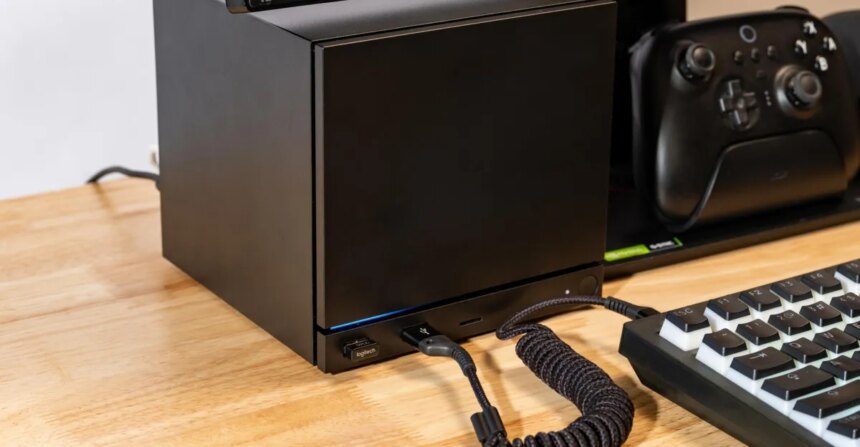
It’s no secret that just about every aspect of video games is getting more expensive. Game consoles are getting regular price hikes, PC components are spiking in cost, and the golden age of affordable handhelds is over, all largely due to the global RAM shortage, which has had a similarly costly impact on PC gaming, including portable devices like the Steam Deck. This all led to some trepidation around the Steam Machine, Valve’s latest attempt to bring the breadth and openness of PC gaming into a form factor designed for your living room. The fact that the device was delayed in February due specifically to the memory crisis only exacerbated this feeling. Now, Valve has finally revealed the Steam Machine’s price tag. And while it may not be quite as expensive as some feared, it’s definitely not cheap, pointing to an increasingly costly future for the console space.
First, here are the details. The most basic Steam Machine, with 512GB of memory, costs $1,049, and bundled with a Steam Controller that price jumps to $1,128. If you want the 2TB version it’ll cost you $1,349, or $1,428 with a controller. That’s not necessarily egregious by PC gaming standards, but the Steam Machine isn’t just competing with other gaming PCs. It’s a device specifically designed to create a console-like experience, and even in the increasingly expensive world of gaming consoles, the Steam Machine costs quite a bit more than its closest competition, up through the higher-end options. A 2TB Xbox Series X now costs $729.99, while a PS5 Pro is $899.99. The cheapest of the bunch, a Switch 2, will be $499.99 starting in September.
Of course, there are benefits to buying a Steam Machine over consoles from Sony, Microsoft, and Nintendo, not least of which is because it includes access to Steam’s absolutely gigantic library of games. That’s a big bonus. But some of the other advantages over a traditional console aren’t quite as obvious, particularly if you’re looking for a pick-up-and-play experience. In fact, performance-wise, the Steam Machine is pretty comparable to a PS5. As my colleague Sean Hollister explained in his Steam Machine review: “you aren’t getting a significant boost in performance over the 5.5-year-old Sony PS5 you can still buy today.” This, despite being nearly twice the price.
It’s hard to fault Valve for the price situation around the Steam Machine. Even Apple, a company worth a few trillion dollars, is planning to raise prices due to the “unsustainable” situation around RAM prices. In a blog post, Valve explained that one of the reasons for the current price is because it’s not using a typical console pricing model. “We think of Steam Machine as an extension of PC gaming, not as a console,” the company says. “The traditional console model is to sell hardware at a loss and make up the revenue with subscription services or by selling games that are locked-in to the hardware. We think this can make sense for a single business in the short term but that open ecosystems are better for customers over the long term.”
But even if Valve says it doesn’t view the Steam Machine as a console, the price tag is another sign that the future of video game consoles is looking increasingly niche. Already, the price increases for the current generation of hardware have had a huge impact. In May, Sony announced that PS5 sales were down 46 percent year over year, following the price of a base PS5 jumping to $649.99, making it $150 more than it was at launch in 2020. Now imagine how things could look if a PS6 launched at $1,000 or more. That seems to be where we’re headed, given that parts continue to get more expensive and platform holders seem less willing or able to subsidize those prices.
The big question is what happens next — and the answer is increasingly unclear. Amid the chaos that is currently consuming Xbox, the company has been slowly teasing details of its next Xbox, codenamed “Project Helix.” But despite initially being pitched as a “premium” device that sits somewhere between a console and PC, it now seems like plans have changed due largely to pricing concerns. “I think we’ve reached a point where it will be hard to imagine that mass audiences can afford thousands of dollars to spend on a console generation, and so I think we will start to see radically different business models that we never expected start to come into orbit later this year,” Xbox CEO Asha Sharma recently said. Sony, meanwhile, hasn’t said much about the PS6 since hinting at some new GPU tech last year, which, presumably, will be pretty costly to implement now.
If you asked me a year ago what the next generation of game consoles was going to look like, I probably would’ve said something like the Steam Machine: devices that straddle the line between a PC and a home console. But now I’m not so sure — and it’s entirely down to the price. The Steam Deck is a largely beloved device, but also one that remains comparably niche, even if it was priced relatively affordably at launch (now, not so much). I imagine the Steam Machine will find a similar trajectory. But historically the biggest game consoles have not been niche in the same way; the Switch, for instance, has sold more than 150 million units, while the PS5 has topped 90 million. But if those “radically different business models” can’t get the price down to something reasonable, it’s hard to imagine the next generation of consoles ever reaching an audience like that.