

Every year on June 20, the world observes World Refugee Day, a moment set aside by the United Nations to honour the courage and resilience of people forced to flee their homes because of war, persecution, violence, and disasters.
The scale of displacement today is staggering. According to global humanitarian agencies, about 41.6 million people are refugees worldwide, having crossed international borders in search of safety. Another 9 million people are asylum seekers, waiting for their claims for protection to be processed.
Yet before many refugees ever cross a border, they first become displaced within their own countries.
These are the people known as Internally Displaced Persons (IDPs)—men, women, and children forced to abandon their homes but who remain within their country’s borders.
Unlike refugees, they do not benefit from the legal protections that come with crossing an international boundary.
Often, they remain trapped in conflict zones, disaster-hit communities, overcrowded camps, or unfamiliar towns where survival itself becomes a daily struggle.
The Internal Displacement Monitoring Centre’s (IDMC) Global Report on Internal Displacement 2026 paints a sobering picture.
During 2025 alone, the world recorded 62.2 million internal displacement movements, comprising 32.3 million movements triggered by conflict and violence and 29.9 million caused by disasters. By the end of the year, a staggering 82.2 million people were living in internal displacement globally.
Behind those massive figures are deeply human stories.
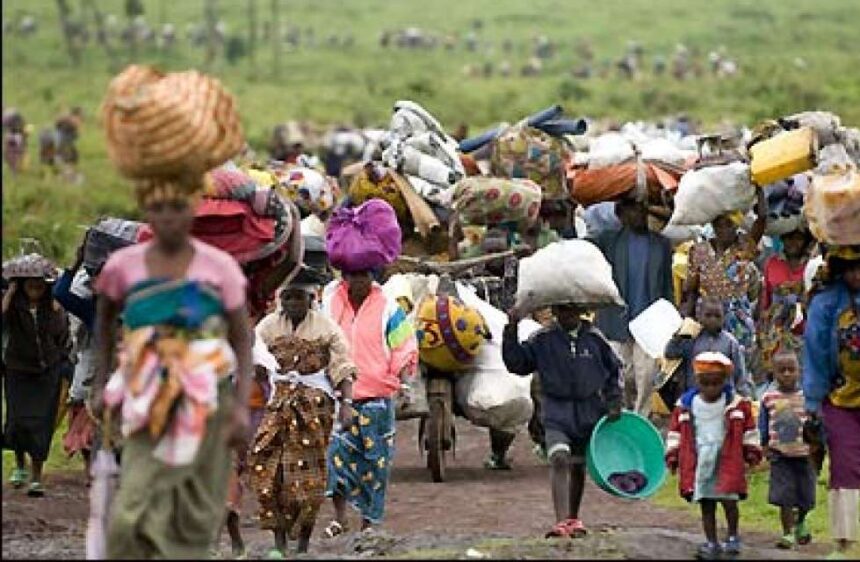
These are stories of families fleeing gunfire in the eastern Democratic Republic of the Congo; mothers carrying children through rising floodwaters in South Sudan; farmers in northern Nigeria abandoning ancestral lands because armed groups have turned villages into battlefields; and children sleeping under plastic tarpaulins after cyclones tear through coastal communities in Mozambique.
As the world remembers refugees today, it is equally important to shine a light on the millions who never crossed a border but lost everything nonetheless.
Using data from the freshly released IDMC Global Report on Internal Displacement 2026, here are the 10 African countries that recorded the highest number of new internal displacements over the past year.
10. Niger — 167,900 new displacements
For many communities in Niger, displacement has become a recurring reality. The country recorded 166,000 conflict-related displacements and another 1,900 linked to disasters. Much of this displacement was driven by worsening insecurity in border regions where armed groups continue to operate across porous frontiers, with the situation deteriorating severely in areas such as Dosso. For families caught in the crossfire, fleeing often means leaving livestock, farms, and entire livelihoods behind with little certainty of when—or if—they can ever return.
9. Madagascar — 177,000 new displacements
Unlike many countries on this list, Madagascar’s displacement crisis was driven entirely by natural disasters. The island nation recorded 177,000 disaster-related displacements as communities continued to face the devastating effects of extreme weather events. Cyclones, severe storms, and flash flooding have increasingly threatened vulnerable settlements, particularly in coastal areas. For many affected households, displacement is not a one-time event; families rebuild their lives only to see the next storm season force them to start over from scratch.
8. Burkina Faso — 316,210 new displacements
Burkina Faso’s displacement crisis remains deeply rooted in structural insecurity. The country recorded approximately 316,000 conflict-related displacements. Large areas of the northern, eastern, and central regions continued to experience violence linked to armed groups. Humanitarian agencies note that due to severe access constraints and reporting challenges, the true figure on the ground may be even higher than recorded. Behind these numbers are emptied villages, abandoned schools, and entire farming communities completely cut off from markets and vital aid.
7. Nigeria — 507,000 new displacements
Nigeria recorded more than half a million internal displacements during the year, comprising 354,000 conflict-related movements and 153,000 disaster-related displacements. According to the IDMC, criminal violence in northwestern states such as Katsina, Sokoto, and Zamfara accounted for nearly 40% of the conflict-driven movements. Simultaneously, communal clashes in Benue State triggered almost 59,000 additional displacements.
The country’s displacement crisis is also deeply protracted; nearly half of Nigeria’s 3.5 million total internally displaced people remain concentrated in Borno State, highlighting the lingering, heavy impact of more than a decade of insurgency in the northeast.
6. Somalia — 549,000 new displacements
Somalia’s displacement crisis reflects a dangerous, overlapping intersection of conflict and climate shocks. The country recorded 214,000 conflict-related displacements and another 335,000 disaster-related movements. Communities continually face insecurity from armed groups while simultaneously battling recurring droughts and volatile flash floods. In many tragic cases, people initially displaced by violence are later hit by climate disasters, creating a cycle of displacement from which escape is incredibly difficult.
5. Ethiopia — 597,000 new displacements
Ethiopia recorded 353,000 conflict-related displacements and 244,000 disaster displacements. While conflict-related movements fell to their lowest level since 2016, localized communal violence continued to flare—particularly in southern regions, where a single July outbreak triggered over 40% of the year’s conflict movements. The country also experienced significant environmental displacement: floods accounted for nearly half of all disaster movements, while a series of earthquakes triggered around 78,000 displacements—the highest earthquake-related figure recorded in sub-Saharan Africa in years.
4. South Sudan — 853,000 new displacements
South Sudan recorded one of the continent’s most complex displacement emergencies, with 364,000 conflict-related displacements and 489,000 disaster displacements. Internal conflict intensified, pushing total conflict-related movements to their highest level since the civil war erupted in 2014, with fighting concentrated heavily in Western Equatoria, Warrap, Jonglei, and Upper Nile states. At the same time, seasonal flooding uprooted nearly half a million people, repeatedly forcing the same populations to flee both violence and nature within the span of a single year.
3. Mozambique — 1.004 million new displacements
Mozambique crossed the grim one-million mark for internal displacements. Conflict in Cabo Delgado reignited after a brief period of relative calm, contributing 339,000 displacements as fighting between armed groups and government forces escalated—with a third of those movements occurring in November alone. However, the country’s largest challenge came from natural disasters. Cyclones Dikeledi and Jude, alongside other severe weather systems, triggered 665,000 disaster-related movements, leaving families along Mozambique’s vulnerable coastline at the mercy of the next storm.
2. Sudan — 1.763 million new displacements
Sudan’s devastating war continues to generate catastrophic human suffering. Although annual displacement levels technically declined from previous peaks, the country still recorded 1.733 million conflict-related movements. Violence remained particularly severe in North Darfur, which saw over 713,000 movements following the tragic destruction of the Zamzam displacement camp and the capture of strategic areas by armed groups. By the end of the year, around 9.1 million people remained displaced inside Sudan—the highest total number of internally displaced people in any single country worldwide for the third consecutive year.
1. Democratic Republic of the Congo — 10.061 million new displacements
No other country on the African continent approached the scale of displacement seen in the Democratic Republic of the Congo. The DRC recorded an astonishing 9.748 million conflict-related displacements and 313,000 disaster displacements, totaling more than 10 million movements.
The crisis was driven largely by the violent resurgence of the M23 armed group in the country’s eastern provinces. Major military offensives in North and South Kivu triggered mass panic as entire cities and towns fell under armed control, with nearly five million displacements occurring during major military advances alone. The humanitarian consequences are severe: widespread fighting has completely disrupted food production, healthcare systems, and clean water infrastructure, leaving millions trapped in overcrowded camps with little hope of returning home soon.