

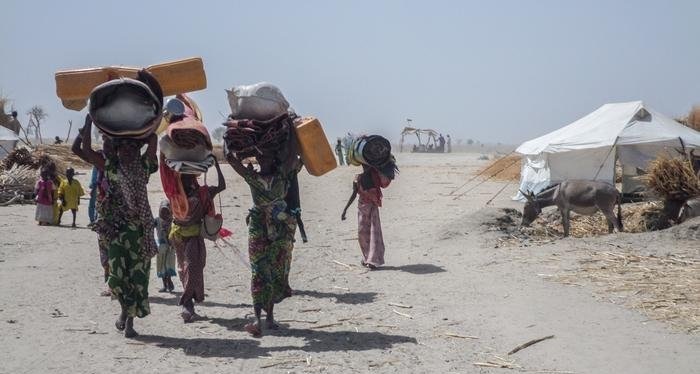
The number of forcibly displaced people in Nigeria reached 3.7 million as of April 2025, according to a new report by UNHCR Africa.
The figure places Nigeria among the worst-affected countries across West and Central Africa, where around 20 million people remain displaced due to conflict, insecurity and extreme weather events.
The figures, contained in UNHCR Africa’s West and Central Africa Regional Trends Report 2026, show that the number of displaced people in the region fell by 4% to 20 million from 20.7 million recorded in April 2025.
However, the decline does not indicate any meaningful easing of displacement pressures across the region, as conflict remains the primary driver of forced migration.
Between January and April 2026 alone, approximately 99,800 new refugees and asylum-seekers were registered across the region. This shows the pace at which fresh displacement continues to occur even as some returns take place in more stable areas.
What UNHCR Africa is saying
According to UNHCR Africa, the small reduction in overall displacement numbers is largely attributable to returns in countries where conditions have improved rather than a genuine decline in the forces pushing people from their homes.
- “While this decline is mainly due to returns to countries where conditions have become more stable, it does not signal a broader reduction in displacement pressures across the region,” the report said
The report also said conflict and insecurity remained the primary drivers of displacement across the region.
- “Conflict and insecurity remained the primary drivers of displacement, increasingly compounded by extreme weather events and rising food insecurity,” the report said.
- UNHCR Africa noted that cross-border movements are placing sustained pressure on asylum systems and host countries, many of which are also dealing with insecurity and weak social infrastructure.
The agency said nearly 932,000 people across the region are at risk of statelessness at the moment.
- “UNHCR estimates nearly 932,000 people are stateless or at risk of statelessness across the region and the real figure is likely far higher,” the report showed
- According to UNHCR Africa, women and children continue to bear the heaviest burden of displacement, accounting for 80% of all refugees and asylum-seekers in the region, a share that has remained unchanged since April 2025.
More insights
The report shows that the vast majority of displaced people across the region, roughly 71%, remain within their own countries, with approximately 14.2 million internally displaced persons recorded as of April 2026.
- The Democratic Republic of Congo hosts the largest IDP population with nearly 5.8 million people, followed by Nigeria with 3.7 million. Burkina Faso is next with nearly 2.1 million and is followed Cameroon with 1 million, based on government statistics.
- Cross-border displacement is rising sharply, with the number of refugees and asylum-seekers reaching 3.9 million as of April 2026, a 23% increase compared to the same period in 2025 and an 18% rise from December 2024. More than half of this population has been in protracted displacement for at least five consecutive years.
- Chad remains the region’s largest host country for refugees and asylum-seekers, currently sheltering 1.5 million people, around 40% of the regional total. The DRC, Niger and Cameroon also host significant refugee populations of around 606,000, 447,000 and 432,000 respectively.
- Sudan, the Central African Republic, Nigeria and Burkina Faso were the main countries of origin, accounting for 1.2 million, 897,000, 440,000 and 433,000 refugees respectively, reflecting the deeply entrenched and cyclical nature of conflict in those countries.
The overall displacement figure of 20 million represents an almost 13% drop compared to the 23 million recorded at the end of 2024, a decline driven primarily by large-scale returns in specific countries rather than any systemic improvement in the conditions that continue to force people from their homes across the region.
What you should know
Earlier, in June 2024, Nairametrics reported that the United Nations Refugee Agency (UNHCR) revealed that it received $181,646,993 in contributions to support its humanitarian operations in Nigeria and other parts of West and Central Africa.
The agency, which provides protection and assistance to refugees, asylum seekers, and internally displaced persons around the world, disclosed the figures in its June report titled “UNHCR Projected Global Resettlement Needs 2025.”
The report also highlighted key developments and funding updates across the region as the organisation continues efforts to address displacement and humanitarian challenges.