


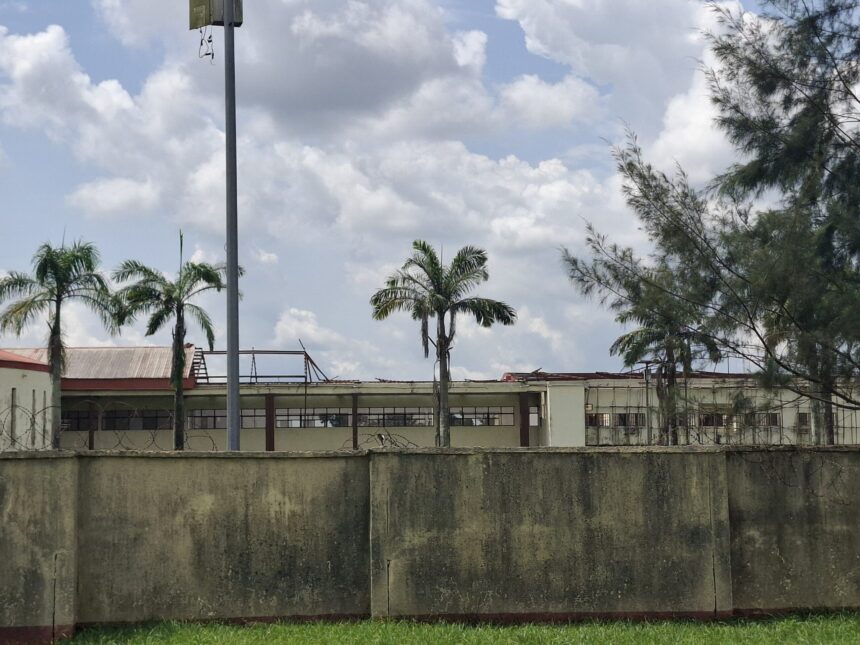

On a sunny Thursday afternoon in June in Uyo, silence hung over the Akwa Ibom State House of Assembly complex, which ought to be under rehabilitation.
The legislative headquarters of one of Nigeria’s richest oil-producing states, with a revenue of N2.53 trillion in 32 months, should have been buzzing with engineers, artisans and construction workers.
Instead, only eight security personnel were visible inside the sprawling premises.
There were no labourers, masons, welders, carpenters, engineers and no sounds of construction.
At the entrance gate, a notice informed visitors that both the Akwa Ibom State House of Assembly and the Akwa Ibom House of Assembly Service Commission had temporarily relocated their offices to Luton Park Hotel, Uyo, owned by a former state lawmaker, pending the completion of rehabilitation works at the complex.


The sign served as a reminder that for more than seven months, the state’s legislature and its administrative machinery have operated away from their permanent headquarters.
What stood before PREMIUM TIMES at the assembly complex was an eerily quiet complex at the centre of a multi-billion-naira rehabilitation project that has already displaced lawmakers from their chambers, triggered political controversy and raised fresh questions about transparency, procurement and the independence of the legislature.
Budget documents reviewed by PREMIUM TIMES show that between 2025 and 2026, the Akwa Ibom State Government approved a total of N15.47 billion for the rehabilitation and remodelling of the assembly complex.
Yet more than seven months after legislative and administrative activities were relocated to pave the way for the project, the complex remains unfinished.
The delay has changed what began as a renovation exercise into a test of public accountability.
Governor’s promise, growing budget
The rehabilitation project gained attention after Governor Umo Eno visited the assembly complex on 1 July 2024 and publicly expressed concern about its condition, promising to ensure its rehabilitation.
In the revised 2025 budget, N2.95 billion was provided for architectural design, construction of a multi-purpose hall, reroofing, replacement of ceilings, tiling and painting of the Assembly complex.
By 2026, the scope had expanded.
Budget documents show provisions for reroofing, ceiling replacement, extensive tiling, painting, structural remodelling, decking, and construction of new office buildings, office finishing, woodwork, cabinets, library facilities, marble flooring, parking lots and installation of an electric security perimeter fence. The allocation for these works totalled N12.52 billion.
Combined with the 2025 provision, the project attracted a total budgetary allocation of N15.47 billion within two years.
Embarrassing security standoff
The lawmakers have been conducting plenary sessions at a facility within the Government House, Uyo, for months, pending the completion of the renovation.
That arrangement recently sparked controversy after lawmakers and security operatives clashed over access procedures at the Government House.
PREMIUM TIMES reported that the disagreement disrupted legislative proceedings and forced the assembly to suspend sitting on 2 June.
The current state of the project contrasts with assurances given before work commenced.
In a circular dated 24 October 2025, referenced AKHA/ADM/087/225, the Clerk of the House, NsikakAbasi Orok, directed lawmakers, assembly staff and other occupants to vacate the complex ahead of rehabilitation works scheduled to begin on 27 October.
Before the relocation, the Akwa Ibom House of Assembly Services Committee met with representatives of the contractor to discuss implementation plans.
According to reports of the meeting reviewed by PREMIUM TIMES, the contractor’s representative, Ochemba Lee, described the project as a comprehensive overhaul of the Assembly complex.
Mr Lee informed lawmakers that the contractor had already been mobilised and that equipment had been deployed to the site. He announced a completion period of six months.
That timeline expired in April 2026, while the lawmakers remain displaced.
More than seven months after the relocation order took effect, a notice posted at the assembly gate still directs visitors to temporary offices at Luton Park Hotel, underscoring the prolonged displacement of both lawmakers and the assembly bureaucracy from the complex.
The prolonged relocation also raises questions about the cost to taxpayers. While government officials did not disclose the terms of the arrangement with the hotel, the continued use of the private facility as a temporary administrative headquarters for the legislature and the Assembly Service Commission is likely attracting significant public expenditure.
PREMIUM TIMES requested details of the arrangement, including its cost implications, but received no response before this report was filed.
What PREMIUM TIMES found
A visit to the assembly complex on 4 June revealed little visible evidence of substantial progress. A large section of the roof covering parts of the reception area and offices had been removed.

The assembly’s chambers appeared largely untouched. The most visible ongoing work was a parapet roof structure around part of the entrance section.

The only major equipment sighted was a mobile crane and a concrete mixer. No construction work was taking place during the visit.

Security personnel stationed at the facility told PREMIUM TIMES that contractors had not been actively working on the site for more than three months.
Residents and business operators around the assembly complex gave similar accounts.
One resident who requested anonymity said workers were last seen consistently at the site between February and March.
“The workers only came to remove the roof. They brought a concrete mixer and worked on the parapet at the entrance for about four days before leaving. We kept hearing them complain that funding was the problem and that was why work was not steady,” the resident said.
PREMIUM TIMES could not independently verify the claim.
Contractor shrouded in uncertainty
The contractor’s identity has also caused confusion.
The October 2025 relocation circular identified the contractor as JDP Construction Nigeria Limited. Yet the project signage at the assembly complex names CLAD Construction Nigeria Limited as the contractor. Also, it was the representatives of CLAD Construction who appeared before the House Services Committee to brief lawmakers about the project.
The discrepancy remains unexplained. The confusion is particularly significant because the state’s procurement law requires greater transparency.
Section 54(5) of the Akwa Ibom State Public Procurement Law, Volume V, Cap 122 of the laws of Akwa Ibom State 2022 mandates the Bureau of Public Procurement and procuring entities to routinely publish procurement information on the state’s electronic procurement portal.
A search conducted by PREMIUM TIMES found no information relating to the assembly rehabilitation project on the portal.
Governor Umo Eno’s administration rarely published details of major state contracts, including contract sums, implementation timelines and procurement records.
Searches of publicly available Corporate Affairs Commission records did not produce identifiable records for JDP Construction Nigeria Limited.
However, records were found for CLAD Construction Nigeria Limited.
According to documents reviewed by PREMIUM TIMES, the company was incorporated on 7 December 2024 for civil engineering business activities.

That means the company was less than a year old when it emerged as the contractor handling one of the state’s most significant public infrastructure projects.
PREMIUM TIMES could not find publicly available records of major completed projects executed by the company before the assembly contract was awarded to it.
The company’s listed address also raised questions.
Project signage identifies its Uyo office as No. 84 Atiku Abubakar Way.
A physical search by PREMIUM TIMES located buildings numbered within the 80 to 90 range, but No. 84 could not be identified.
Several residents and business operators approached by the newspaper said they were unfamiliar with the company.
READ ALSO: Akwa Ibom University still missing in updated list of accredited law programmes
PREMIUM TIMES was, however, able to trace both CLAD Construction and JDP Construction to a project jointly awarded to both companies in Degema Local Government Area of Rivers State around April 2026.
Whether one company replaced the other, whether both are jointly executing the assembly project, or whether a formal variation occurred remains unclear.
Missing answers, missing records
On 4 June, PREMIUM TIMES sent detailed enquiries to the Head of Operations of the Direct Labour Committee, Morgan Ekanem.
PREMIUM TIMES sought clarification on the contractor’s identity, procurement procedures, contract value, amounts released, project completion status, and the reasons for the delay.
The paper also requested the legal basis for the committee’s supervision of a project funded under the Akwa Ibom State House of Assembly budget.
The enquiries were acknowledged, but no response had been received as of the time of filing this report.
The State Commissioner for Information, Aniekan Umanah, also did not respond to our request for comment on the matter.
One critical question remains unanswered: how much of the N15.47 billion approved for the project has been released or spent?
Neither the Direct Labour Committee nor any government official provided payment records, mobilisation details, valuation certificates, or evidence of the project’s financial status.
Without such records, it remains impossible to determine how much of the public funds has been expended relative to the work on site.
The silence is particularly questionable because Section 16(16) of the state’s procurement law guarantees public access to procurement records.
The law specifically requires that procurement records contain contractor identities, contract values, award dates, procurement proceedings, technical specifications and other information necessary for public accountability.
Assembly leaders defend project
When contacted, the Chairman of the House Services Committee, Lawrence Udoide, dismissed concerns about delays.
“There is no issue. Work is ongoing,” he told PREMIUM TIMES.
Asked about the six-month completion period communicated to lawmakers before work commenced, Mr Udoide described it as a projection.
“Even road construction, you can project six months or one year. When rain comes, the projection may not be realised. But as we speak, work is ongoing,” he said.
When pressed for details of completed works and the challenges affecting implementation, he requested that the newspaper call back later.
His phone line was unreachable in subsequent attempts to reach him. He also did not respond to a detailed follow-up enquiry.
The Chairman of the House Committee on Information, Jerry Otu, initially declined to comment. “Construction is not part of my business,” he said.
“If they want to finish tomorrow, fine and good. I cannot speak categorically on when we will return to the House. The project falls under the executive,” he added.
When informed that the project is funded through the assembly’s budget, Mr Otu disagreed.
He later defended Governor Eno.
“I cannot say anything that the governor is not doing this or that. No, no, no. The governor has tried. It might not be 100 per cent because he is not God. The governor has done his best.”
Beyond the building
The controversy surrounding the assembly rehabilitation project is no longer merely about a roof, offices or a legislative chamber; It is about transparency in public fund spending, which PREMIUM TIMES’ investigation shows has slipped under Mr Eno’s administration. It is about whether procurements by the administration align with procurement laws enacted by the state and the ability of a constitutionally independent legislature to control projects funded from its own budget.
More than N15 billion has been approved for the project. Yet key questions remain unanswered. Who exactly was awarded the contract? How much has been paid? What procurement process was followed? What percentage of the project has been completed? Why did a project expected to be completed in April 2026 remain unfinished months later?
Neither the Direct Labour Committee, the state government, nor the House of Assembly provided answers before this report was filed.
At the assembly complex itself, the signs of delay are difficult to miss: stripped roofing sheets, parapet executed only at the entrance, idle equipment and security personnel guarding a site where no active construction was visible.
The delay has consequences beyond the unfinished structure itself. As lawmakers and assembly officials continue to operate from temporary facilities, questions also arise about the public cost of maintaining alternative offices while the rehabilitation project remains incomplete. The government has not disclosed how much, if any, is being paid for the continued use of the temporary facility.
Until those questions are answered, the Akwa Ibom State House of Assembly complex will stand not merely as a construction site but as a symbol of the increasing disparity between public expenditure and public accountability.