

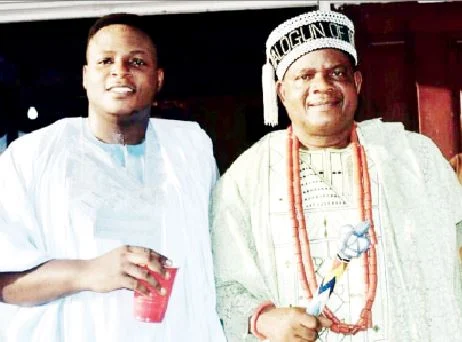

Oluwatobi Oyewo is the youngest of the five sons of legendary actor, scholar and cultural icon, Kola Oyewo, who died on Friday aged 80. In this interview with WALE AKINSELURE, Oluwatobi recounts his father’s final moments and values that defined his life and legacy
Tell us about the final moments before your dad’s death…
He passed on Friday at about 6:30pm. Two days before he died, he had been talking in a way that was mysterious. He was speaking in parables. My immediate elder brother had been in Ife for a while, taking care of him. His family stays in Ife, so he had been with them for some time. In a way, he was talking in parables as if he was ready to go. He kept telling my brother that it was sad that he would be leaving behind such good children. My eldest brother still had a video call with him on Friday morning. They joked and laughed. He was in the hospital. My brother asked Daddy if he was on his way home. He responded that, yes, he was going home. But we later realised that while my brother was talking about going back home to Ife, I think he was referring to transitioning. He was just talking in parables. Our mum is late; we lost her in 2020. There was a point when he kept mentioning her name as if she was in the vicinity. He kept saying, “Aduke, mo ti se tan o” (Aduke, I am now ready).
Your dad once disclosed that he had an enlarged prostate. Was he able to overcome it before his death on Friday?
Just as he disclosed during an interview he granted Kunle Afod, he had an enlarged prostate. He was diagnosed in 2019 and had been managing it since then. He had the first surgery, which was successful and sustained him. He was fine. In fact, he was the one who drove himself around. But we realised that towards the end of last year, his condition started deteriorating. The normal things he could do, like driving himself around, he could no longer do. Because of his age, there was no way we could have told him to undergo another surgery. The doctor even said it was a 50-50 situation, and he wasn’t convinced about having the surgery. You can’t force someone to do what he doesn’t want to do. Moreover, he acknowledged that he had fulfilled his purpose in life. There was nothing else he wanted that he hadn’t achieved. He was also happy to see all of us grow. He had been preparing. In fact, I remember when I came home in May and he couldn’t look me in the eyes. Sometimes, when our eyes met, he would just shake his head and bow it. He felt that he was leaving us and didn’t want us to be stressed. He didn’t like the fact that we had to take him to the hospital repeatedly to bring him back. My dad was a very strong person. Before this ailment and everything that followed, he had never spent a night in a hospital throughout his life. He had never been admitted. He was used to travelling from one location to another. He enjoyed driving a lot. Growing up, I remember that my dad drove almost all over the country. If you asked him how to get anywhere in Nigeria, he would tell you the route because he had travelled almost everywhere in the country. If he wasn’t driving, he was travelling around with his theatre troupe. He was used to being active and constantly on the move. It was really disheartening for him to be in that state, and he kept feeling that he was a burden to us.
You mentioned Kunle Afod’s visit. Were there other thespians that rallied around him while he was on the sick bed?
Yes, there were other people. Some called us the children to ask about how he was faring. Of course, some couldn’t come physically, but Uncle Kunle was the one who took the bold step. I think he was doing something on his channel, visiting veteran actors one after another. He was the one who even made the whole thing public. There were other people too. Toyin Adegbola visited and called. Others always came around, visited, and called us as children to check on him. They were really supportive to the best of their ability. There’s nothing anyone can do when it’s time. I’m happy that we, the children, did our best, and he was really happy about it.
What principles guided your father’s life?
He believed strongly in hard work, responsibility and humility. That’s one thing I can say I personally learnt from him. My dad was a very humble person. He was so humble that in my parish in Ife, before old age slowed him down, he used to play the konga drum in the choir. Since his death, many of his videos have resurfaced online. What gladdens you most about his legacy? I feel proud to be associated with someone who achieved so much and was genuinely loved by people. All the comments I have been reading have been heartwarming and positive. There have been so many positive comments about him. That gladdens my heart. I feel proud to say that he was my father, even though he is no longer with us. Although, I also think about the fact that the shoes he left behind are very big ones to fill.
Is there any of his children also involved in the arts?
My eldest brother is a lecturer in Theatre Arts, so he is partly involved in acting. My second brother also acts, mostly in television series and Africa Magic productions rather than regular home videos. Those are the two people I can say are really involved in acting. The other three of us have gone into different professions.
What were his final wishes?
The major thing he preached was humility and unity among his children. He always told us to remain united and to listen to our eldest brother because he would now serve as a father figure to us. That is Dr Wale Oyewo. He also encouraged us to remain prayerful and keep the faith. As a Catholic, he was always passionate about keeping the faith alive. I remember telling him that I had become the Parish Pastoral Council Chairman of my parish. He was really surprised and happy. Things like that thrilled him. He was always glad whenever I came home to worship in our parish and saw that I was receiving Holy Communion. He was happy that I remained part of the fold because he was a very devoted Catholic. He worshipped at St. Mary’s Catholic Church, Igboya, Ife.
How would you like him to be remembered?
I would love him to be remembered as the legend that he was. Even though he was my father and someone I could call at any time, that does not diminish the fact that he was a legend. People saw him as a mentor and someone they could always look up to. I would love him to be remembered for the impact he made, especially in academics and theatre arts.
What posthumous honour would you like Nigeria to bestow on him?
I wouldn’t know exactly. There was a time during his birthday when the President released a congratulatory message. Now, the President has also condoled with the family. I don’t know what specific honours are usually given in situations like this. Maybe the MFR or something similar. It would be really nice if he received an honour like that so that his name would remain in the history books as a great achiever.
Would you say your father lived a fulfilled life?
Yes, definitely. I would say he lived a fulfilled life because there was virtually nothing he wanted to achieve that he didn’t achieve, at least to the best of his ability, considering his humble background. In fact, he had almost no chance of making it out of our village in Osun State. Yet here he is, being celebrated, with news of his passing making headlines across the country. I was really surprised yesterday when I saw so many news organisations reporting it. I was amazed and asked myself, “Is my dad really this legendary?”
His command of Yoruba was exceptional. Did he deliberately pass that on to his children?
Yes, he did. That’s why, despite the growing dominance of English, our Yoruba language skills remain deeply ingrained. I usually tell people that I didn’t learn English at home; I learnt it in school. My dad would never speak English to us at home. I knew how to speak Yoruba fluently from a very young age. He only spoke Yoruba to us. I can’t imagine my dad saying things like, “Sit there” or “Don’t do this” in English. If you heard my dad speaking English, it probably meant he was angry because you had done something wrong. You hardly heard him speak English. I’m sure it was the same for all my other four brothers. We are five men in total. We learnt English in school, not at home. It’s different from what we see nowadays, where many parents speak only English to their children from infancy.
But was he tempted to speak English when his grandchildren came around?
Yes, but he still tried to instil Yoruba in them. That’s why all of us have traditional names — what Yoruba people call oríkì names. I’ve never heard him call me by my given name, Tobi, except perhaps when referring to me to someone else. He would always call me by my native name, Akano. Everyone has a native name, including our wives. Once we got married, he gave each of our wives a native name. My wife even said yesterday that she hopes her native name won’t go extinct because he’s the only person who calls her Agbeke. All the grandchildren also have native names, and that’s what he called them.Whenever they were around, he tried to speak Yoruba to them rather than English.
Did he maintain a personal library or archive at home for his many works, probably it could be set aside as a historical room of some sort?
No, he didn’t have a formal library or archive. But I know where his books are. He had a lot of books on the shelves in his room. There were many books, though not what I would describe as a formal archive or library.